A student is taking a 40-question multiple-choice exam. Each question has five possible answers. Because the student did not study, he guesses on every question. Using 0 or 1 to represent a correct answer, use the following line of random digits to simulate the probability that the student will guess a question correctly.
73634 79304 78871 25956 59109 30573 18513 61760
Verified step by step guidance
1
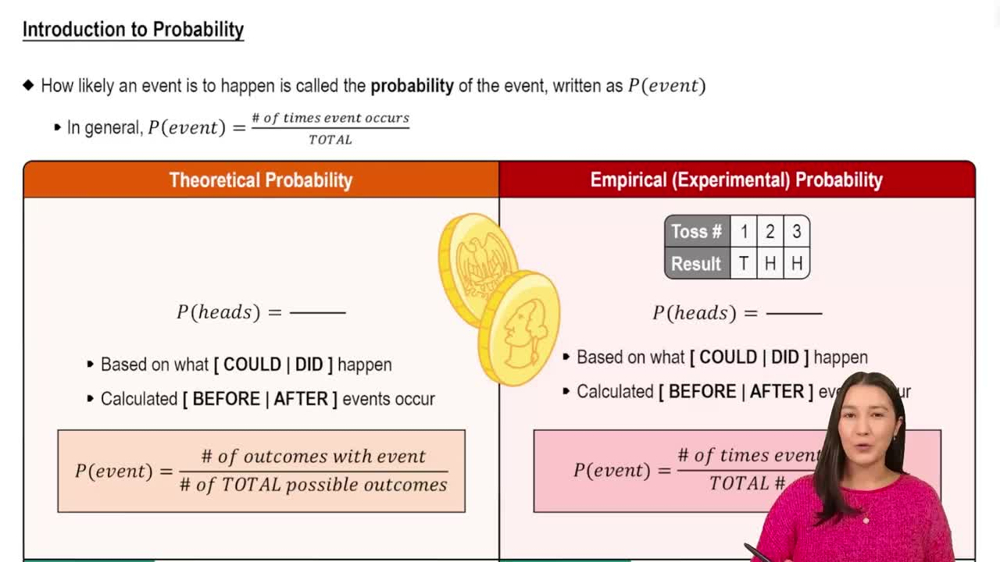
Understand that each question has 5 possible answers, so the probability of guessing a question correctly is \(\frac{1}{5} = 0.2\).
To simulate guessing using the given random digits, assign a range of digits to represent a correct answer. For example, since there are 5 choices, you can divide digits 0-9 into 5 equal groups of 2 digits each: 0-1 for choice 1, 2-3 for choice 2, 4-5 for choice 3, 6-7 for choice 4, and 8-9 for choice 5.
Choose one group to represent a correct answer (for example, digits 0 and 1). Then, go through the random digits provided and count how many digits fall into this 'correct' group.
Each digit corresponds to one question guess. Since there are 40 questions, use the first 40 digits from the random number sequence to simulate the student's guesses.
Calculate the simulated probability of a correct guess by dividing the number of digits in the 'correct' group by 40, which estimates the probability that the student guesses correctly.
Verified video answer for a similar problem:
This video solution was recommended by our tutors as helpful for the problem above
Video duration:
2m
Play a video:
0 Comments
Key Concepts
Here are the essential concepts you must grasp in order to answer the question correctly.
Binomial Distribution
The binomial distribution models the number of successes in a fixed number of independent trials, each with the same probability of success. Here, each question is a trial with a 1/5 chance of guessing correctly. Understanding this helps calculate probabilities related to the number of correct guesses.
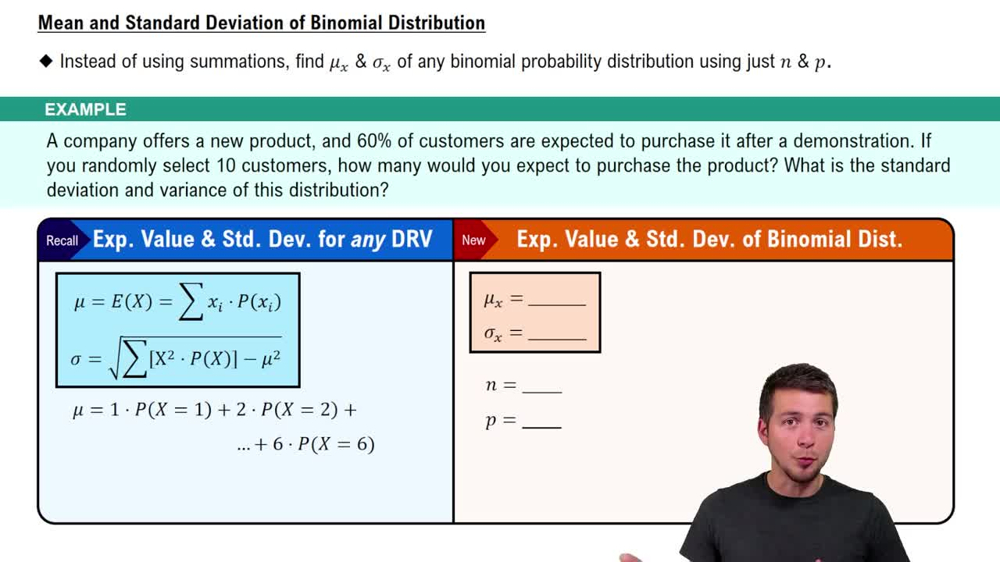
Mean & Standard Deviation of Binomial Distribution
Random Number Simulation
Random number simulation uses sequences of digits to mimic random events. By mapping digits to outcomes (e.g., digits 0-1 for correct, others for incorrect), we can simulate guessing on multiple-choice questions to estimate probabilities empirically.
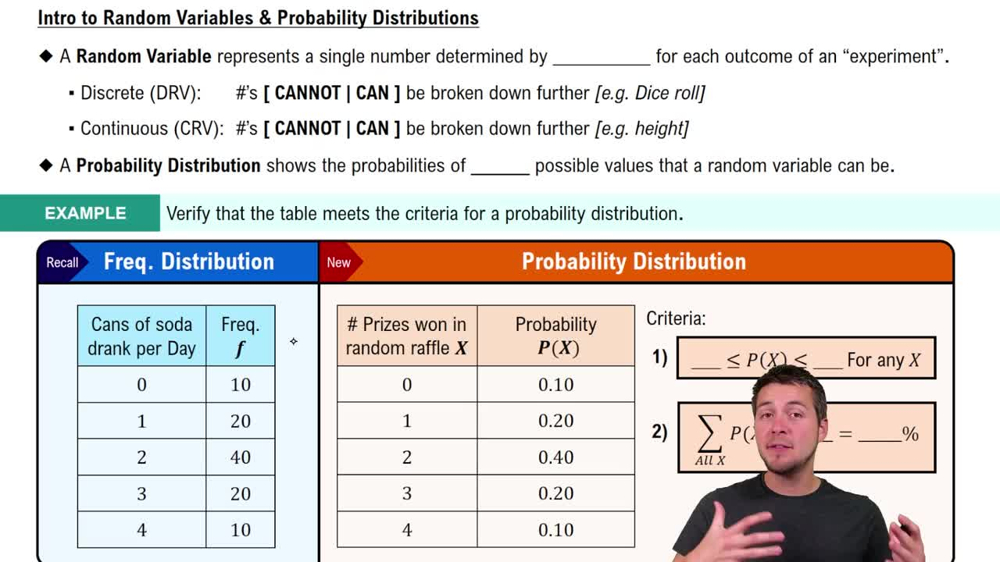
Intro to Random Variables & Probability Distributions
Probability of Success in Guessing
Since each question has five choices, the probability of guessing correctly is 1/5 or 0.2. This fixed probability is essential for modeling the guessing process and interpreting the simulation results accurately.

 2:08 minutes
 Verified step by step guidance
 03:28
03:28