Understand that in statistics, an "unusual event" refers to an outcome or observation that is significantly different from what is expected under a given probability model.
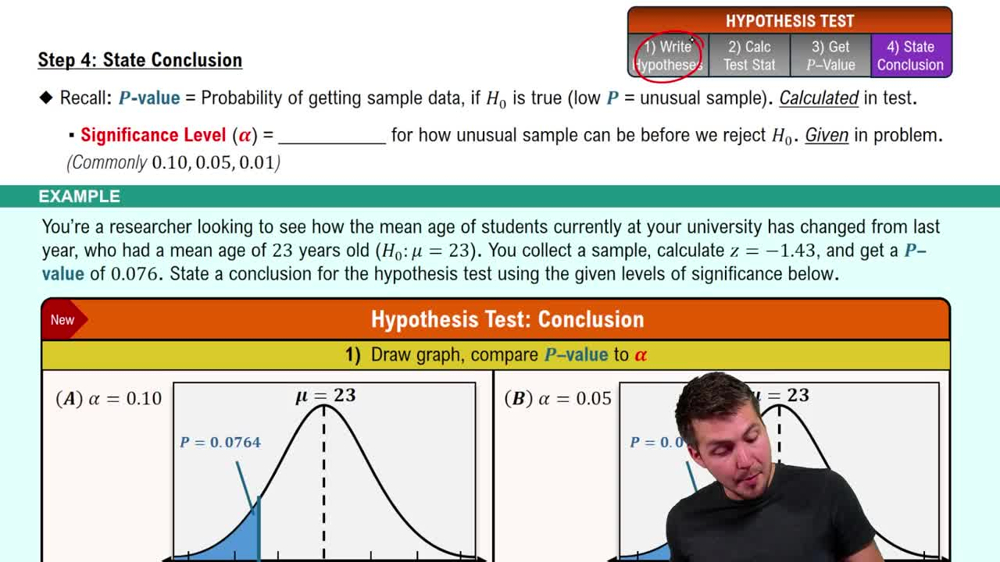
Recall that an event is often considered unusual if its probability of occurrence is very low, typically less than 5% (or 0.05) in many contexts.
Formally, if \(P(E)\) denotes the probability of event \(E\), then event \(E\) is unusual if \(P(E) < 0.05\).
This threshold is a conventional guideline and helps identify outcomes that are rare or surprising under the assumed model.
Recognize that identifying unusual events is important for hypothesis testing and decision-making, as such events may suggest that the underlying assumptions or models need to be reconsidered.
Verified video answer for a similar problem:
This video solution was recommended by our tutors as helpful for the problem above
Video duration:
1m
Play a video:
0 Comments
Key Concepts
Here are the essential concepts you must grasp in order to answer the question correctly.
Unusual Event
An unusual event in statistics refers to an outcome or occurrence that has a very low probability of happening, typically less than 5%. It is considered rare or unexpected within the context of a given probability model or experiment.
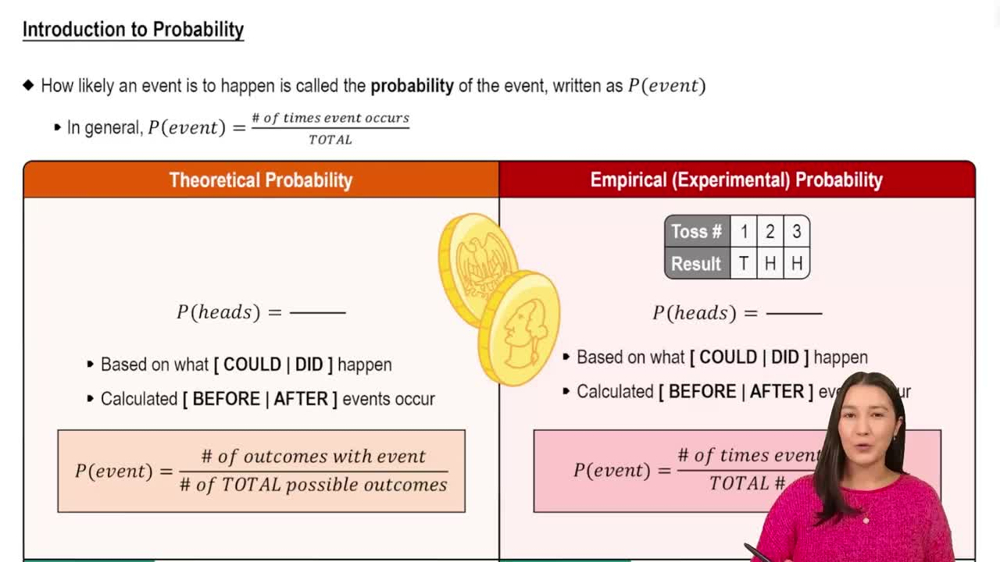
Probability measures the likelihood of an event occurring, expressed as a number between 0 and 1. Understanding probability helps determine how rare or common an event is, which is essential for identifying unusual events.
The threshold for classifying an event as unusual is often set at a probability less than 0.05 (5%). This cutoff helps distinguish between common and rare events, guiding decisions in hypothesis testing and statistical inference.

 1:46 minutes
 Verified step by step guidance

 05:54
05:54