Step 1: Recall the definition of a probability model. A probability model assigns probabilities to all possible outcomes of a random experiment such that each probability is between 0 and 1 inclusive, and the sum of all probabilities equals 1.
Step 2: Examine each probability value in the table to check if it lies within the valid range [0, 1]. Notice that the probability for Green is -0.3, which is less than 0 and therefore invalid.
Step 3: Sum all the probabilities given in the table: 0.3 (Red) + (-0.3) (Green) + 0.2 (Blue) + 0.4 (Brown) + 0.2 (Yellow) + 0.2 (Orange). This sum should be equal to 1 for a valid probability model.
Step 4: Since one of the probabilities is negative, the sum will not represent a valid total probability, violating the fundamental rule that total probability must be exactly 1.
Step 5: Conclude that the table is not a valid probability model because it contains a negative probability and the sum of probabilities does not satisfy the required condition.
Verified video answer for a similar problem:
This video solution was recommended by our tutors as helpful for the problem above
Video duration:
1m
Play a video:
0 Comments
Key Concepts
Here are the essential concepts you must grasp in order to answer the question correctly.
Definition of a Probability Model
A probability model assigns probabilities to all possible outcomes of a random experiment. These probabilities must satisfy two conditions: each probability is between 0 and 1, and the sum of all probabilities equals 1. This ensures the model accurately represents the likelihood of each outcome.
Probabilities cannot be negative because they represent the likelihood of an event occurring, which cannot be less than zero. A negative probability value, such as -0.3 in the table, violates this fundamental rule and invalidates the probability model.
Finding Values of Non-Standard Normal Variables from Probabilities
Sum of Probabilities Must Equal One
The total probability of all possible outcomes in a model must add up to exactly 1, representing certainty that one of the outcomes will occur. If the sum is greater or less than 1, the model does not correctly represent a complete set of outcomes.

 1:59 minutes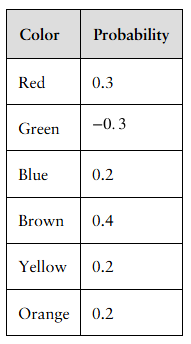
 Verified step by step guidance
 5:37
5:37