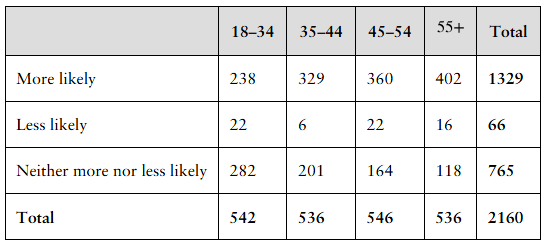
[NW] Made in America In a recent Harris Poll, a random sample of adult Americans (18 years and older) was asked, “When you see an ad emphasizing that a product is ‘Made in America,’ are you more likely to buy it, less likely to buy it, or neither more nor less likely to buy it?” The results of the survey, by age group, are presented in the following contingency table. c. Are 18- to 34-year-olds more likely to buy a product emphasized as ""Made in America"" than individuals in general?
Verified step by step guidance
1
Identify the total number of 18- to 34-year-olds surveyed, which is given in the table as 542.
Find the number of 18- to 34-year-olds who responded 'More likely' to buy a product emphasized as 'Made in America,' which is 238.
Calculate the proportion of 18- to 34-year-olds who are more likely to buy the product by dividing the number who said 'More likely' by the total number in that age group: \(\frac{238}{542}\).
Next, find the total number of all respondents surveyed, which is 2160, and the total number of respondents who said 'More likely,' which is 1329.
Calculate the overall proportion of respondents who are more likely to buy the product by dividing the total 'More likely' responses by the total respondents: \(\frac{1329}{2160}\). Then compare this proportion to the proportion for the 18- to 34-year-olds to determine if this age group is more likely to buy the product than individuals in general.
Verified video answer for a similar problem:
This video solution was recommended by our tutors as helpful for the problem above
Video duration:
4m
Play a video:
Was this helpful?
Key Concepts
Here are the essential concepts you must grasp in order to answer the question correctly.
Contingency Tables
A contingency table displays the frequency distribution of variables and helps analyze the relationship between categorical variables. In this case, it shows how different age groups respond to the likelihood of buying 'Made in America' products. Understanding how to read and interpret these tables is essential for comparing groups.
Relative frequency is the proportion of observations in a category relative to the total number of observations. To determine if 18- to 34-year-olds are more likely to buy the product, calculate the proportion of 'More likely' responses within that age group and compare it to the overall proportion. This comparison reveals differences in behavior between groups.
Comparative analysis involves comparing proportions or percentages across groups to identify significant differences. Here, it means comparing the likelihood of buying 'Made in America' products between 18-34-year-olds and the general population. This helps determine if younger adults have a distinct buying preference.