When the -value is used for hypothesis testing, the null hypothesis is rejected if which of the following is true?
Table of contents
- 1. Intro to Stats and Collecting Data1h 14m
- 2. Describing Data with Tables and Graphs1h 55m
- 3. Describing Data Numerically2h 5m
- 4. Probability2h 16m
- 5. Binomial Distribution & Discrete Random Variables3h 6m
- 6. Normal Distribution and Continuous Random Variables2h 11m
- 7. Sampling Distributions & Confidence Intervals: Mean3h 23m
- Sampling Distribution of the Sample Mean and Central Limit Theorem19m
- Distribution of Sample Mean - Excel23m
- Introduction to Confidence Intervals15m
- Confidence Intervals for Population Mean1h 18m
- Determining the Minimum Sample Size Required12m
- Finding Probabilities and T Critical Values - Excel28m
- Confidence Intervals for Population Means - Excel25m
- 8. Sampling Distributions & Confidence Intervals: Proportion1h 25m
- 9. Hypothesis Testing for One Sample3h 29m
- 10. Hypothesis Testing for Two Samples4h 50m
- Two Proportions1h 13m
- Two Proportions Hypothesis Test - Excel28m
- Two Means - Unknown, Unequal Variance1h 3m
- Two Means - Unknown Variances Hypothesis Test - Excel12m
- Two Means - Unknown, Equal Variance15m
- Two Means - Unknown, Equal Variances Hypothesis Test - Excel9m
- Two Means - Known Variance12m
- Two Means - Sigma Known Hypothesis Test - Excel21m
- Two Means - Matched Pairs (Dependent Samples)42m
- Matched Pairs Hypothesis Test - Excel12m
- 11. Correlation1h 24m
- 12. Regression1h 50m
- 13. Chi-Square Tests & Goodness of Fit2h 21m
- 14. ANOVA1h 57m
9. Hypothesis Testing for One Sample
Steps in Hypothesis Testing
Problem 12.3A.3b
Textbook Question
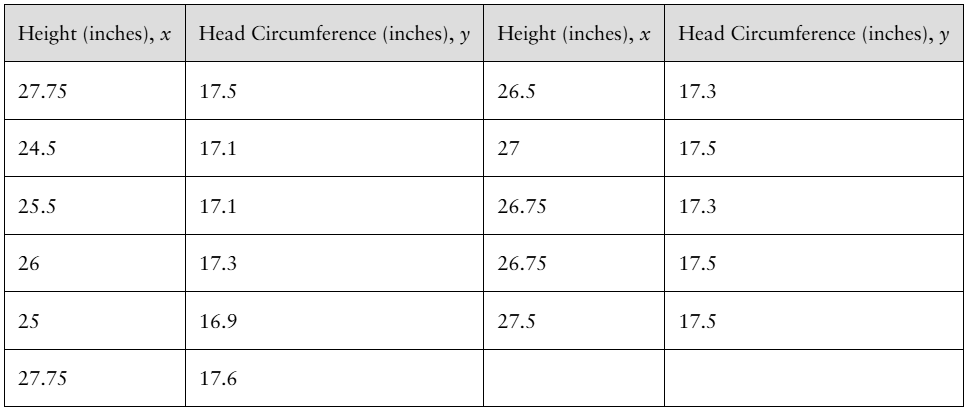
"[DATA] Height versus Head Circumference [See Problem 13 in Section 12.3] A pediatrician wants to determine the relation that may exist between a child’s height and head circumference. She randomly selects 11 children from her practice, measures their heights and head circumferences, and obtains the following data:

b. Suppose the researcher wanted to determine if there is a positive association between height and head circumference. What would be the null and alternative hypotheses?"
Verified step by step guidance1
Step 1: Identify the parameter of interest. Here, the pediatrician wants to determine if there is a positive association between height (x) and head circumference (y). This association is typically measured by the population correlation coefficient, denoted as \(\rho\).
Step 2: Formulate the null hypothesis (\(H_0\)). The null hypothesis usually states that there is no association or no positive association between the two variables. In terms of the correlation coefficient, this means \(H_0: \rho \leq 0\).
Step 3: Formulate the alternative hypothesis (\(H_a\)). Since the researcher wants to test if there is a positive association, the alternative hypothesis will be that the correlation coefficient is greater than zero: \(H_a: \rho > 0\).
Step 4: Understand the context of the hypotheses. The null hypothesis assumes no positive linear relationship or a negative/no correlation, while the alternative hypothesis assumes a positive linear relationship between height and head circumference.
Step 5: These hypotheses set the stage for a one-tailed test of correlation, where the test statistic will be calculated from the sample data to determine if there is sufficient evidence to reject the null hypothesis in favor of the alternative.
Verified video answer for a similar problem:This video solution was recommended by our tutors as helpful for the problem above
Video duration:
1mPlay a video:
Was this helpful?
Key Concepts
Here are the essential concepts you must grasp in order to answer the question correctly.
Hypothesis Testing
Hypothesis testing is a statistical method used to decide whether there is enough evidence to reject a null hypothesis in favor of an alternative hypothesis. It involves formulating two opposing statements about a population parameter and using sample data to assess their validity.
Recommended video:
Performing Hypothesis Tests: Proportions
Null and Alternative Hypotheses
The null hypothesis (H0) typically states that there is no effect or no association between variables, while the alternative hypothesis (Ha) suggests the presence of an effect or association. In this context, H0 would state no positive association between height and head circumference, and Ha would state a positive association.
Recommended video:
Guided course
Step 1: Write Hypotheses
Correlation and Association
Correlation measures the strength and direction of a linear relationship between two quantitative variables. A positive association means that as one variable increases, the other tends to increase as well. Understanding correlation helps in formulating hypotheses about relationships between variables.
Recommended video:
Guided course
Correlation Coefficient
Watch next
Master Step 1: Write Hypotheses with a bite sized video explanation from Patrick
Start learningRelated Videos
Related Practice
Multiple Choice
11
views