
Ch. 4 - Probability
Triola - Elementary Statistics 14th Edition
Triola14th EditionElementary StatisticsISBN: 9780137366446Not the one you use?Change textbook
Chapter 4, Problem 4.3.1

Language: Complement of “At Least One” Let A=the event of getting at least one defective calculator when four are randomly selected with replacement from a batch. Write a statement describing event A

Verified step by step guidance
1
Step 1: Understand the problem. The event A is defined as 'getting at least one defective calculator' when four calculators are randomly selected with replacement. This means we are interested in the complement of the event where all four calculators are non-defective.
Step 2: Recall the complement rule in probability. The complement of an event A is the event that A does not occur. Mathematically, P(A) = 1 - P(A').
Step 3: Define the complement of event A. The complement of event A (denoted as A') is the event where none of the four calculators selected are defective. This means all four calculators are non-defective.
Step 4: Write a statement describing event A. Event A can be described as 'at least one of the four calculators selected is defective.' This is equivalent to saying 'not all four calculators are non-defective.'
Step 5: Use the complement rule to calculate probabilities if needed. To find the probability of event A, you would calculate P(A) = 1 - P(A'), where P(A') is the probability that all four calculators are non-defective.

Verified video answer for a similar problem:

This video solution was recommended by our tutors as helpful for the problem above.
Video duration:
1m
Was this helpful?

Key Concepts

Here are the essential concepts you must grasp in order to answer the question correctly.

Complementary Events

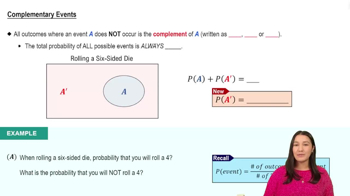
In probability, the complement of an event A is the event that A does not occur. For example, if A is the event of getting at least one defective calculator, the complement would be the event of getting no defective calculators at all. Understanding complementary events is crucial for calculating probabilities, as the sum of the probabilities of an event and its complement equals one.
Recommended video:
4:23
Complementary Events

Probability with Replacement

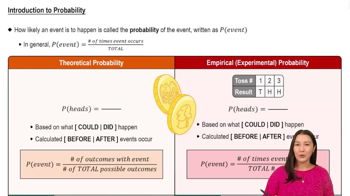
When selecting items from a batch with replacement, each selection is independent of the others. This means that the probability of selecting a defective calculator remains constant for each of the four selections. This concept is essential for accurately calculating the likelihood of events when the same item can be chosen multiple times.
Recommended video:
5:37
Introduction to Probability

At Least One Probability

The phrase 'at least one' refers to the probability of an event occurring one or more times in a series of trials. To find this probability, it is often easier to calculate the complement (the probability of the event not occurring at all) and subtract it from one. This approach simplifies the calculation, especially in scenarios involving multiple trials.
Recommended video:
5:37
Introduction to Probability
Related Practice
Textbook Question

Pick 10 Lottery For the New York Pick 10 lottery, the player first selects 10 numbers from 1 to 80. Then there is an official drawing of 20 numbers from 1 to 80. The prize of \$500,000 is won if the 10 numbers selected by the player are all included in the 20 numbers that are drawn. Find the probability of winning that prize.

209
views
Textbook Question

Shared Birthdays Find the probability that of 25 randomly selected people, at least 2 share the same birthday.

187
views
Textbook Question

Unseen Coins A statistics professor tosses two coins that cannot be seen by any students. One student asks this question: “Did one of the coins turn up heads?” Given that the professor’s response is “yes,” find the probability that both coins turned up heads.

129
views
Textbook Question

In Exercises 13–20, express the indicated degree of likelihood as a probability value between 0 and 1.


Square Peg Sydney Smith wrote in “On the Conduct of the Understanding” that it is impossible to fit a square peg in a round hole.

131
views
Textbook Question

Composite Drug Test Based on the data in Table 4-1, assume that the probability of a randomly selected person testing positive for drug use is 0.126. If drug screening samples are collected from 5 random subjects and combined, find the probability that the combined sample will reveal a positive result. Is that probability low enough so that further testing of the individual samples is rarely necessary?

200
views
Textbook Question

Jumble Many newspapers carry “Jumble,” a puzzle in which the reader must unscramble letters to form words. The letters MHRHTY were included in newspapers on the day this exercise was written. How many ways can those letters be arranged? Identify the correct unscrambling, then determine the probability of getting that result by randomly selecting one arrangement of the given letters.

206
views