
Births: Sampling Distribution of Sample Proportion When two births are randomly selected, the sample space for genders is bb, bg, gb, and gg (where and Assume that those four outcomes are equally likely. Construct a table that describes the sampling distribution of the sample proportion of girls from two births. Does the mean of the sample proportions equal the proportion of girls in two births? Does the result suggest that a sample proportion is an unbiased estimator of a population proportion?
Table of contents
- 1. Intro to Stats and Collecting Data1h 14m
- 2. Describing Data with Tables and Graphs1h 55m
- 3. Describing Data Numerically2h 5m
- 4. Probability2h 16m
- 5. Binomial Distribution & Discrete Random Variables3h 6m
- 6. Normal Distribution and Continuous Random Variables2h 11m
- 7. Sampling Distributions & Confidence Intervals: Mean3h 23m
- Sampling Distribution of the Sample Mean and Central Limit Theorem19m
- Distribution of Sample Mean - Excel23m
- Introduction to Confidence Intervals15m
- Confidence Intervals for Population Mean1h 18m
- Determining the Minimum Sample Size Required12m
- Finding Probabilities and T Critical Values - Excel28m
- Confidence Intervals for Population Means - Excel25m
- 8. Sampling Distributions & Confidence Intervals: Proportion2h 10m
- 9. Hypothesis Testing for One Sample5h 9m
- Steps in Hypothesis Testing1h 6m
- Performing Hypothesis Tests: Means1h 4m
- Hypothesis Testing: Means - Excel42m
- Performing Hypothesis Tests: Proportions37m
- Hypothesis Testing: Proportions - Excel27m
- Performing Hypothesis Tests: Variance12m
- Critical Values and Rejection Regions28m
- Link Between Confidence Intervals and Hypothesis Testing12m
- Type I & Type II Errors17m
- 10. Hypothesis Testing for Two Samples5h 37m
- Two Proportions1h 13m
- Two Proportions Hypothesis Test - Excel28m
- Two Means - Unknown, Unequal Variance1h 3m
- Two Means - Unknown Variances Hypothesis Test - Excel12m
- Two Means - Unknown, Equal Variance15m
- Two Means - Unknown, Equal Variances Hypothesis Test - Excel9m
- Two Means - Known Variance12m
- Two Means - Sigma Known Hypothesis Test - Excel21m
- Two Means - Matched Pairs (Dependent Samples)42m
- Matched Pairs Hypothesis Test - Excel12m
- Two Variances and F Distribution29m
- Two Variances - Graphing Calculator16m
- 11. Correlation1h 24m
- 12. Regression3h 33m
- Linear Regression & Least Squares Method26m
- Residuals12m
- Coefficient of Determination12m
- Regression Line Equation and Coefficient of Determination - Excel8m
- Finding Residuals and Creating Residual Plots - Excel11m
- Inferences for Slope31m
- Enabling Data Analysis Toolpak1m
- Regression Readout of the Data Analysis Toolpak - Excel21m
- Prediction Intervals13m
- Prediction Intervals - Excel19m
- Multiple Regression - Excel29m
- Quadratic Regression15m
- Quadratic Regression - Excel10m
- 13. Chi-Square Tests & Goodness of Fit2h 21m
- 14. ANOVA2h 28m
8. Sampling Distributions & Confidence Intervals: Proportion
Sampling Distribution of Sample Proportion
Problem 6.3.18c
Textbook Question
Hybridization A hybridization experiment begins with four peas having yellow pods and one pea having a green pod. Two of the peas are randomly selected with replacement from this population.
c. Is the mean of the sampling distribution [from part (b)] equal to the population proportion of peas with yellow pods? Does the mean of the sampling distribution of proportions always equal the population proportion?
Verified step by step guidance1
Step 1: Begin by understanding the problem. The population consists of 4 peas with yellow pods and 1 pea with a green pod. This means the population proportion of peas with yellow pods is p = 4/5 = 0.8. The question asks about the mean of the sampling distribution of proportions and whether it equals the population proportion.
Step 2: Recall the formula for the mean of the sampling distribution of proportions. The mean of the sampling distribution of proportions (denoted as μ_p̂) is equal to the population proportion (p). Mathematically, μ_p̂ = p.
Step 3: Since the sampling is done with replacement, the probability of selecting a yellow pod remains constant at 0.8 for each draw. This ensures that the sampling distribution of proportions is unbiased, and its mean will equal the population proportion.
Step 4: Address the second part of the question. The mean of the sampling distribution of proportions always equals the population proportion, provided the sampling is random and unbiased. This is a fundamental property of the sampling distribution of proportions.
Step 5: Conclude that in this specific case, the mean of the sampling distribution of proportions is indeed equal to the population proportion of peas with yellow pods, which is 0.8. This result holds true for any random sampling process with replacement.
Verified video answer for a similar problem:This video solution was recommended by our tutors as helpful for the problem above
Video duration:
1mPlay a video:
Was this helpful?
Key Concepts
Here are the essential concepts you must grasp in order to answer the question correctly.
Sampling Distribution
A sampling distribution is the probability distribution of a statistic obtained from a larger population. It describes how the sample statistic (like the sample mean or proportion) varies from sample to sample. In this context, it refers to the distribution of the proportions of yellow pods obtained from repeated random samples of the pea population.
Recommended video:
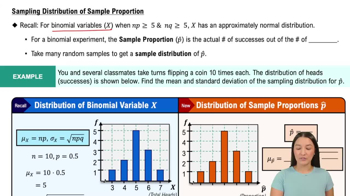
Sampling Distribution of Sample Proportion
Mean of the Sampling Distribution
The mean of the sampling distribution, also known as the expected value, is the average of all possible sample means or proportions. According to the Central Limit Theorem, this mean will equal the population mean or proportion when the sample size is sufficiently large, regardless of the population's distribution. In this case, it questions whether the mean of the sampling distribution of proportions matches the population proportion of yellow pods.
Recommended video:
Sampling Distribution of Sample Proportion
Law of Large Numbers
The Law of Large Numbers states that as the size of a sample increases, the sample mean will get closer to the population mean. This principle underpins the idea that the mean of the sampling distribution of proportions will converge to the true population proportion as more samples are taken. It emphasizes the reliability of sample statistics in estimating population parameters when the sample size is large.
Recommended video:
Guided course
Find 5-Number Summary - TI-84 Calculator
Watch next
Master Using the Normal Distribution to Approximate Binomial Probabilities with a bite sized video explanation from Patrick
Start learningRelated Videos
Related Practice
Textbook Question
109
views
