
Ch. 4 - Discrete Probability Distributions
Larson - Elementary Statistics: Picturing the World 8th Edition
Larson8th EditionElementary Statistics: Picturing the WorldISBN: 9780137493470Not the one you use?Change textbook
Chapter 4, Problem 4.RE.13a

In Exercises 13–16, find the indicated binomial probabilities. If convenient, use technology or Table 2 in Appendix B.
Fifty-three percent of U.S. adults support attempting to land an astronaut on Mars. You randomly select eight U.S. adults. Find the probability that the number who support attempting to land an astronaut on Mars is (a) exactly three

Verified step by step guidance
1
Step 1: Recognize that this is a binomial probability problem. The binomial distribution is used when there are a fixed number of independent trials (n), each with two possible outcomes (success or failure), and the probability of success (p) is constant for each trial. Here, n = 8 (number of trials), p = 0.53 (probability of success), and we are finding the probability of exactly 3 successes (x = 3).
Step 2: Write the formula for the binomial probability: P(X = x) = (n choose x) * p^x * (1 - p)^(n - x). Here, (n choose x) is the binomial coefficient, which can be calculated as (n! / (x! * (n - x)!)).
Step 3: Substitute the given values into the formula. For this problem, n = 8, x = 3, and p = 0.53. The formula becomes: P(X = 3) = (8 choose 3) * (0.53)^3 * (1 - 0.53)^(8 - 3).
Step 4: Calculate the binomial coefficient (8 choose 3). This is given by (8! / (3! * (8 - 3)!)), which simplifies to (8! / (3! * 5!)).
Step 5: Substitute the binomial coefficient and probabilities into the formula. Compute (0.53)^3 and (1 - 0.53)^5, then multiply these values by the binomial coefficient to find the probability. If needed, use technology or a statistical calculator to simplify the computation.

Verified video answer for a similar problem:

This video solution was recommended by our tutors as helpful for the problem above.
Video duration:
2m
Was this helpful?

Key Concepts

Here are the essential concepts you must grasp in order to answer the question correctly.

Binomial Probability

Binomial probability refers to the probability of obtaining a fixed number of successes in a fixed number of independent Bernoulli trials, each with the same probability of success. The formula for calculating binomial probability is P(X = k) = (n choose k) * p^k * (1-p)^(n-k), where n is the number of trials, k is the number of successes, and p is the probability of success on each trial.
Recommended video:
Guided course
06:39
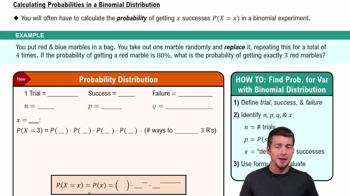
Calculating Probabilities in a Binomial Distribution

Parameters of a Binomial Distribution

In a binomial distribution, two key parameters are defined: n, the number of trials, and p, the probability of success on each trial. In this scenario, n is 8 (the number of adults surveyed) and p is 0.53 (the probability that an adult supports the Mars landing). Understanding these parameters is essential for calculating the desired probabilities.
Recommended video:
Guided course
03:28
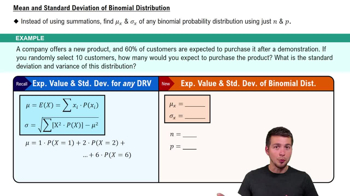
Mean & Standard Deviation of Binomial Distribution

Combinatorial Coefficient

The combinatorial coefficient, often represented as 'n choose k' or C(n, k), calculates the number of ways to choose k successes from n trials. It is computed using the formula C(n, k) = n! / (k!(n-k)!), where '!' denotes factorial. This coefficient is crucial in binomial probability calculations as it accounts for the different arrangements of successes and failures.
Recommended video:
Guided course
06:14
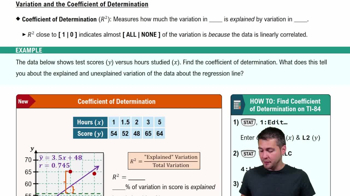
Coefficient of Determination
Related Practice
Textbook Question

The Centers for Disease Control and Prevention (CDC) is required by law to publish a report on assisted reproductive technology (ART). ART includes all fertility treatments in which both the egg and the sperm are used. These procedures generally involve removing eggs from a patient’s ovaries, combining them with sperm in the laboratory, and returning them to the patient’s body or giving them to another patient.

You are helping to prepare a CDC report on young ART patients and select at random 6 ART cycles of patients under 35 years of age for a special review. None of the cycles resulted in a live birth. Your manager feels it is impossible to select at random 10 ART cycles that do not result in a live birth. Use the pie chart at the right and your knowledge of statistics to determine whether your manager is correct.

a. How would you determine whether your manager is correct, that it is impossible to select at random six ART cycles that do not result in a live birth?

86
views
Textbook Question

In Exercises 13–16, find the indicated binomial probabilities. If convenient, use technology or Table 2 in Appendix B.

Seventy-two percent of U.S. civilian employees have access to medical care benefits. You randomly select nine civilian employees. Find the probability that the number who have access to medical care benefits is (b) at least six

89
views
Textbook Question

In Exercises 1–7, consider a grocery store that can process a total of four customers at its checkout counters each minute.

Minitab was used to generate 20 random numbers with a Poisson distribution for . Let the random number represent the number of arrivals at the checkout counter each minute for 20 minutes. 3 3 3 3 5 5 6 7 3 6 3 5 6 3 4 6 2 2 4 1During each of the first four minutes, only three customers arrived. These customers could all be processed, so there were no customers waiting after four minutes.

b. Create a table that shows the number of customers waiting at the end of 1 through 20 minutes.

81
views
Textbook Question

In Exercises 13–16, find the indicated binomial probabilities. If convenient, use technology or Table 2 in Appendix B.

Seventy-two percent of U.S. civilian employees have access to medical care benefits. You randomly select nine civilian employees. Find the probability that the number who have access to medical care benefits is (a) exactly six

87
views
Textbook Question

In Exercises 13–16, find the indicated binomial probabilities. If convenient, use technology or Table 2 in Appendix B.

Fifty-three percent of U.S. adults support attempting to land an astronaut on Mars. You randomly select eight U.S. adults. Find the probability that the number who support attempting to land an astronaut on Mars is (c) more than three.

85
views
Textbook Question

The Centers for Disease Control and Prevention (CDC) is required by law to publish a report on assisted reproductive technology (ART). ART includes all fertility treatments in which both the egg and the sperm are used. These procedures generally involve removing eggs from a patient’s ovaries, combining them with sperm in the laboratory, and returning them to the patient’s body or giving them to another patient.

You are helping to prepare a CDC report on young ART patients and select at random 6 ART cycles of patients under 35 years of age for a special review. None of the cycles resulted in a live birth. Your manager feels it is impossible to select at random 10 ART cycles that do not result in a live birth. Use the pie chart at the right and your knowledge of statistics to determine whether your manager is correct.

b. What probability distribution do you think best describes the situation? Do you think the distribution of the number of live births is discrete or continuous? Explain your reasoning.

84
views