
Ch. 4 - Probability
Triola - Elementary Statistics 14th Edition
Triola14th EditionElementary StatisticsISBN: 9780137366446Not the one you use?Change textbook
Chapter 4, Problem 4.1.19

In Exercises 13–20, express the indicated degree of likelihood as a probability value between 0 and 1.


Square Peg Sydney Smith wrote in “On the Conduct of the Understanding” that it is impossible to fit a square peg in a round hole.

Verified step by step guidance
1
Understand the problem: The task is to express the degree of likelihood of an event (in this case, the impossibility of fitting a square peg into a round hole) as a probability value between 0 and 1. Probability values range from 0 (impossible event) to 1 (certain event).
Recall the definition of probability: Probability is a measure of how likely an event is to occur. An event that is described as 'impossible' has a probability of 0.
Interpret the statement: The phrase 'it is impossible to fit a square peg in a round hole' indicates that the event cannot occur under any circumstances.
Assign the probability value: Based on the interpretation of 'impossible,' assign a probability value of 0 to this event.
Conclude: The probability of fitting a square peg into a round hole, as described in the problem, is 0. This is the final probability value expressed between 0 and 1.

Verified video answer for a similar problem:

This video solution was recommended by our tutors as helpful for the problem above.
Video duration:
1m
Was this helpful?

Key Concepts

Here are the essential concepts you must grasp in order to answer the question correctly.

Probability

Probability is a measure of the likelihood that a particular event will occur, expressed as a value between 0 and 1. A probability of 0 indicates that the event cannot happen, while a probability of 1 indicates certainty that the event will occur. Understanding how to calculate and interpret probabilities is essential for analyzing situations involving uncertainty.
Recommended video:
5:37
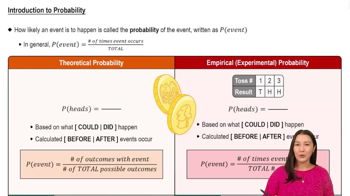
Introduction to Probability

Event

In probability theory, an event is a specific outcome or a set of outcomes from a random experiment. For example, in the context of fitting a square peg into a round hole, the event could be defined as 'the peg fits.' Identifying the event of interest is crucial for determining its probability.
Recommended video:
05:54
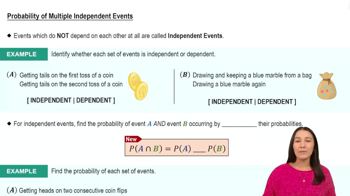
Probability of Multiple Independent Events

Sample Space

The sample space is the set of all possible outcomes of a random experiment. In the case of fitting a square peg into a round hole, the sample space would include all configurations of the peg and hole. Understanding the sample space helps in calculating the probability of specific events by providing a complete context for the possible outcomes.
Recommended video:
05:11
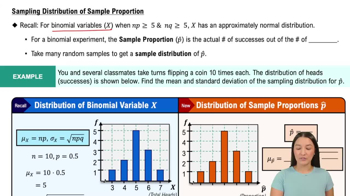
Sampling Distribution of Sample Proportion
Related Practice
Textbook Question

Soccer Shootout In the FIFA Women’s World Cup 2019, a tie at the end of two overtime periods leads to a “shootout” with five kicks taken by each team from the penalty mark. Each kick must be taken by a different player. How many ways can 5 players be selected from the 11 eligible players? For the 5 selected players, how many ways can they be designated as first, second, third, fourth, and fifth?

160
views
Textbook Question

Pick 10 Lottery For the New York Pick 10 lottery, the player first selects 10 numbers from 1 to 80. Then there is an official drawing of 20 numbers from 1 to 80. The prize of \$500,000 is won if the 10 numbers selected by the player are all included in the 20 numbers that are drawn. Find the probability of winning that prize.

209
views
Textbook Question

Shared Birthdays Find the probability that of 25 randomly selected people, at least 2 share the same birthday.

187
views
Textbook Question

Language: Complement of “At Least One” Let A=the event of getting at least one defective calculator when four are randomly selected with replacement from a batch. Write a statement describing event A

195
views
Textbook Question

Composite Drug Test Based on the data in Table 4-1, assume that the probability of a randomly selected person testing positive for drug use is 0.126. If drug screening samples are collected from 5 random subjects and combined, find the probability that the combined sample will reveal a positive result. Is that probability low enough so that further testing of the individual samples is rarely necessary?

200
views
Textbook Question

Jumble Many newspapers carry “Jumble,” a puzzle in which the reader must unscramble letters to form words. The letters MHRHTY were included in newspapers on the day this exercise was written. How many ways can those letters be arranged? Identify the correct unscrambling, then determine the probability of getting that result by randomly selecting one arrangement of the given letters.

206
views