Ch. 4 - Probability
Triola - Elementary Statistics 14th Edition
Triola14th EditionElementary StatisticsISBN: 9780137366446Not the one you use?Change textbook
Chapter 4, Problem 4.1.14

In Exercises 13–20, express the indicated degree of likelihood as a probability value between 0 and 1.


SAT Test When making a random guess for an answer to a multiple choice question on an SAT test, the possible answers are a, b, c, d, e, so there is 1 chance in 5 of being correct.

Verified step by step guidance
1
Step 1: Understand the problem. The question asks for the probability of correctly guessing the answer to a multiple-choice question with 5 possible answers (a, b, c, d, e).
Step 2: Recall the formula for probability. Probability is calculated as the ratio of favorable outcomes to the total number of possible outcomes. Mathematically, this is expressed as: P=Favorable OutcomesTotal Outcomes
Step 3: Identify the favorable and total outcomes. In this case, there is 1 favorable outcome (the correct answer) and 5 total possible outcomes (the 5 answer choices).
Step 4: Substitute the values into the probability formula. Using the formula from Step 2, substitute 1 for the favorable outcomes and 5 for the total outcomes: P=15
Step 5: Simplify the fraction if necessary. In this case, the fraction 15 is already in its simplest form, so this represents the probability of correctly guessing the answer.

Verified video answer for a similar problem:

This video solution was recommended by our tutors as helpful for the problem above.
Video duration:
1m
Was this helpful?

Key Concepts

Here are the essential concepts you must grasp in order to answer the question correctly.

Probability

Probability is a measure of the likelihood that a particular event will occur, expressed as a value between 0 and 1. A probability of 0 indicates that the event cannot happen, while a probability of 1 indicates certainty. In the context of the SAT question, the probability of guessing the correct answer from five options is calculated as the number of successful outcomes (1 correct answer) divided by the total number of possible outcomes (5 options).
Recommended video:
5:37
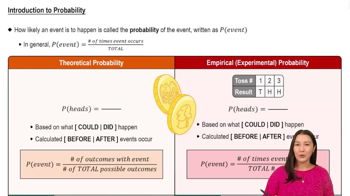
Introduction to Probability

Random Guessing

Random guessing refers to making a choice without any knowledge or strategy, relying solely on chance. In the SAT example, when a student guesses an answer among five choices (a, b, c, d, e), each option has an equal likelihood of being selected. This concept is crucial for understanding how to calculate the probability of success when no prior knowledge influences the decision.
Recommended video:
Guided course
07:09
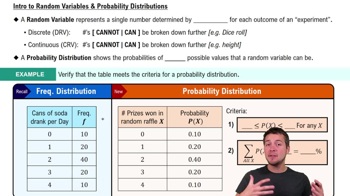
Intro to Random Variables & Probability Distributions

Multiple Choice Questions

Multiple choice questions present respondents with several answer options, from which they must select the correct one. The structure of these questions allows for straightforward probability calculations, as each option can be treated as an independent event. In the SAT scenario, knowing there are five choices helps in determining the probability of selecting the correct answer through random guessing.
Recommended video:
05:54
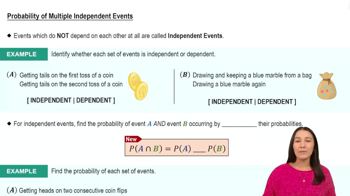
Probability of Multiple Independent Events
Related Practice
Textbook Question

Notation What does the symbol ! represent? The five starting players of an NBA basketball team can stand in a line 5! different ways, so what is the actual number of ways that the five players can stand in a line?

230
views
Textbook Question

Notation For a polygraph (lie detector) used when a subject is presented with a question, let L= the subject lied and let Y = the polygraph indicated that the subject told a lie. Use your own words to translate the notation P (Y|L) into a verbal statement.

122
views
Textbook Question

Penicillin “Who discovered penicillin: Marcel Bich, William Penn, Jonas Salk, Alexander Fleming, or Louis Pasteur?” If you make a random guess for the answer to that question, what is the probability that your answer is the correct answer of Alexander Fleming?

105
views
Textbook Question

In Exercises 21-28, find the probability and answer the questions.


Mendelian Genetics When Mendel conducted his famous genetics experiments with peas, one sample of offspring consisted of 428 green peas and 152 yellow peas. Based on those results, estimate the probability of getting an offspring pea that is green. Is the result reasonably close to the expected value of as Mendel claimed?

212
views
Textbook Question

In Exercises 21-28, find the probability and answer the questions.


YSORT Gender Selection MicroSort’s YSORT gender selection technique is designed to increase the likelihood that a baby will be a boy. At one point before clinical trials of the YSORT gender selection technique were discontinued, 291 births consisted of 239 baby boys and 52 baby girls (based on data from the Genetics & IVF Institute). Based on these results, what is the probability of a boy born to a couple using MicroSort’s YSORT method? Does it appear that the technique is effective in increasing the likelihood that a baby will be a boy?

181
views
Textbook Question

Laundry Symbols Based on a New Generation of Stains survey, 13% of U.S. adults know that the care-instruction symbol on clothing means that any bleach can be used. Find the probability of randomly selecting an adult in the U.S. who does not know that.

158
views