
Ch. 4 - Probability
Triola - Elementary Statistics 14th Edition
Triola14th EditionElementary StatisticsISBN: 9780137366446Not the one you use?Change textbook
Chapter 4, Problem 4.1.4

Subjective Probability Estimate the probability that the next time that you approach an escalator, you find it to be in operation.

Verified step by step guidance
1
Understand the concept of subjective probability: Subjective probability is based on personal judgment, experience, or intuition rather than objective data. It reflects an individual's belief about the likelihood of an event occurring.
Identify factors that influence the probability: Consider factors such as the location of the escalator (e.g., a busy mall versus a less frequented building), the time of day, and your past experiences with escalators in similar settings.
Assign a probability value: Based on your judgment and past experiences, assign a probability value between 0 and 1 to represent the likelihood of the escalator being in operation. For example, if you believe escalators are operational 80% of the time in similar situations, you might assign a probability of 0.8.
Acknowledge the subjective nature: Note that this probability is not derived from empirical data or mathematical calculations but rather from your personal assessment and reasoning.
Consider gathering data for a more objective estimate: If you want a more accurate probability, you could collect data on the operational status of escalators in similar settings over time and calculate the relative frequency of operational escalators.

Verified video answer for a similar problem:

This video solution was recommended by our tutors as helpful for the problem above.
Video duration:
1m
Was this helpful?

Key Concepts

Here are the essential concepts you must grasp in order to answer the question correctly.

Subjective Probability

Subjective probability refers to the individual's personal judgment or belief about the likelihood of an event occurring, rather than relying on objective data or statistical analysis. It is influenced by personal experiences, intuition, and biases, making it inherently variable among different people. For example, someone who frequently uses escalators may estimate a higher probability of them being operational based on their past experiences.
Recommended video:
5:37
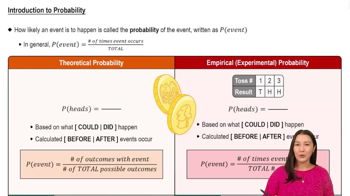
Introduction to Probability

Probability Estimation

Probability estimation involves assessing the likelihood of a specific event happening, often expressed as a number between 0 and 1, where 0 indicates impossibility and 1 indicates certainty. In the context of the escalator, one might consider factors such as the time of day, location, and maintenance schedules to inform their estimate. This process can be both qualitative and quantitative, depending on the information available.
Recommended video:
5:37
Introduction to Probability

Event Context

The context of an event plays a crucial role in probability estimation, as it encompasses the specific circumstances and conditions surrounding the event. For the escalator scenario, factors like the location (e.g., a busy mall vs. a rarely used building), time of day, and historical data on escalator functionality can significantly influence the perceived probability. Understanding the context helps refine subjective estimates and align them more closely with reality.
Recommended video:
05:54
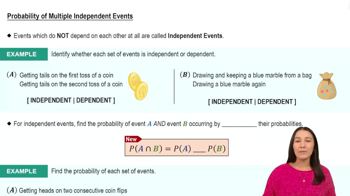
Probability of Multiple Independent Events
Related Practice
Textbook Question

DNA Nucleotides DNA (deoxyribonucleic acid) is made of nucleotides. Each nucleotide can contain any one of these nitrogenous bases: A (adenine), G (guanine), C (cytosine), T (thymine). If one of those four bases (A, G, C, T) must be selected three times to form a linear triplet, how many different triplets are possible? All four bases can be selected for each of the three components of the triplet.

247
views
Textbook Question

Notation When randomly selecting adults, let M denote the event of randomly selecting a male and let B denote the event of randomly selecting someone with blue eyes. What does P (M|B) represent? Is P (M|B) the same as P (B|M)?

155
views
Textbook Question

In Exercises 21–24, use these results from the “1-Panel-THC” test for marijuana use, which is provided by the company Drug Test Success: Among 143 subjects with positive test results, there are 24 false positive (incorrect) results; among 157 negative results, there are 3 false negative (incorrect) results. (Hint: Construct a table similar to Table 4-1.)


Testing for Marijuana Use If one of the test subjects is randomly selected, find the probability that the subject tested positive or did not use marijuana.

157
views
Textbook Question

ZIP Code If you randomly select five digits, each between 0 and 9, with repetition allowed, what is the probability you will get the author’s ZIP code?

147
views
Textbook Question

In Exercises 33–40, use the given probability value to determine whether the sample results are significant.


Voting Repeat Exercise 33 after replacing 40 Democrats being placed on the first line of voting ballots with 14 Democrats being placed on the first line. The probability of getting a result as low as 14 is 0.029792.

101
views