Ch. 4 - Probability
Triola - Elementary Statistics 14th Edition
Triola14th EditionElementary StatisticsISBN: 9780137366446Not the one you use?Change textbook
Chapter 4, Problem 4.q.5

Subjective Probability Estimate the probability that the next time you watch a TV news report, it includes a story about a plane crash.

Verified step by step guidance
1
Understand the concept of subjective probability: Subjective probability is based on personal judgment, experience, or intuition rather than objective data. It reflects an individual's belief about the likelihood of an event occurring.
Identify the factors influencing your subjective probability: Consider how often you personally encounter news stories about plane crashes, your perception of their frequency, and any recent events that might bias your judgment.
Account for external data if available: While subjective probability is personal, you can still consider general statistics, such as the frequency of plane crashes reported in the news, to inform your estimate.
Formulate your subjective probability: Based on your judgment and any relevant information, assign a probability value between 0 and 1 (e.g., 0.1 for a 10% chance) to represent the likelihood of encountering a plane crash story in the next TV news report you watch.
Reflect on potential biases: Recognize that subjective probabilities can be influenced by factors like recent events (availability bias) or personal experiences, and adjust your estimate if necessary to ensure it aligns with your overall understanding.

Verified video answer for a similar problem:

This video solution was recommended by our tutors as helpful for the problem above.
Video duration:
2m
Was this helpful?

Key Concepts

Here are the essential concepts you must grasp in order to answer the question correctly.

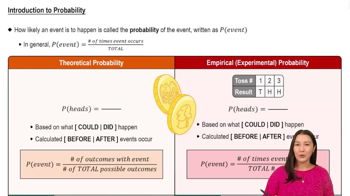
Subjective Probability

Subjective probability is an individual's personal judgment or estimate of the likelihood of an event occurring, based on their own experiences, beliefs, and information. Unlike objective probability, which is based on statistical data, subjective probability can vary significantly from person to person. For example, someone who frequently hears about plane crashes may estimate a higher probability of seeing such a story on the news.
Recommended video:
5:37
Introduction to Probability

Event Probability

Event probability refers to the likelihood of a specific event happening, expressed as a number between 0 and 1, or as a percentage. In the context of the question, it involves estimating the chance that a news report will feature a plane crash story. Understanding how to assess the frequency and context of similar past events can help in making this estimation.
Recommended video:
05:54
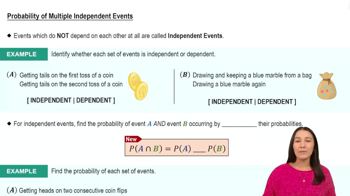
Probability of Multiple Independent Events

Cognitive Bias

Cognitive bias refers to systematic patterns of deviation from norm or rationality in judgment, which can affect how probabilities are estimated. For instance, the availability heuristic may lead someone to overestimate the likelihood of plane crashes if they recall recent news stories about them. Recognizing these biases is crucial for making more accurate subjective probability assessments.
Related Practice
Textbook Question

ESP A psychologist tells you that in an ESP (extrasensory perception) experiment, there is a 20% chance of answering a question correctly. What is the probability of answering a question correctly?

173
views
Textbook Question

Standard Tests Standard tests, such as the SAT or ACT or MCAT, tend to make extensive use of multiple-choice questions because they are easy to grade using software. If one such multiple choice question has possible correct answers of a, b, c, d, e, what is the probability of a wrong answer if the answer is a random guess?

200
views
Textbook Question

Mega Millions As of this writing, the Mega Millions lottery is run in 44 states. Winning the jackpot requires that you select the correct five different numbers from 1 to 70 and, in a separate drawing, you must also select the correct single number from 1 to 25.


c. How does the probability compare to the probability for the old Mega Millions game which involved the selection of five different numbers between 1 and 75 and a separate single number between 1 and 15?

163
views
Textbook Question

Births in the United States In the United States, the true probability of a baby being a boy is 0.512 (based on the data available at this writing). For a family having three children, find the following.


d. The probability that at least one of the children is a girl.

236
views
Textbook Question

Sampling Eye Color Based on a study by Dr. P. Sorita Soni at Indiana University, assume that eye colors in the United States are distributed as follows: 40% brown, 35% blue, 12% green, 7% gray, 6% hazel.


d. If two people are randomly selected, what is the probability that at least one of them has brown eyes?

139
views
Textbook Question

In Exercises 6–10, use the following results from tests of an experiment to test the effectiveness of an experimental vaccine for children (based on data from USA Today). Express all probabilities in decimal form.


If 1 of the 1602 subjects is randomly selected, find the probability of getting 1 who had the vaccine treatment and developed flu.

129
views