

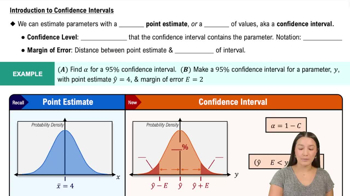
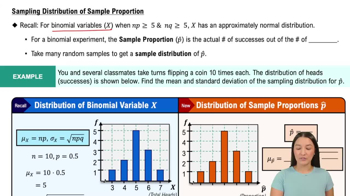
Female Motorcycle Owners Here is a 95% confidence interval estimate of the percentage of motorcycle owners who are female: 17.5%<p<20.6% (based on data from the Motorcycle Industry Council). What is the best point estimate of the percentage of motorcycle owners who are women?
Triola 14th Edition
Ch. 7 - Estimating Parameters and Determining Sample Sizes
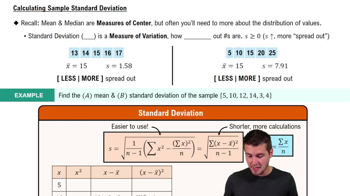
Problem 7.3.14Mint Specs Listed below are weights (grams) from a simple random sample of pennies produced after 1983 (from Data Set 40 “Coin Weights” in Appendix B). Construct a 95% confidence interval estimate of for the population of such pennies. What does the confidence interval suggest about the U.S. Mint specifications that now require a standard deviation of 0.0230 g for weights of pennies?

Verified step by step guidance
Verified video answer for a similar problem:
Key Concepts
Confidence Interval
Standard Deviation
Simple Random Sample
Sample Size for Mean Find the sample size required to estimate the mean IQ of airline pilots. Assume that we want 99% confidence that the mean from the sample is within two IQ points of the true population mean. Also assume that sigma=15
Determining Sample Size. Assume that each sample is a simple random sample obtained from a normally distributed population.
You want to estimate for the population of diastolic blood pressures of air traffic controllers in the United States. Find the minimum sample size needed to be 95% confident that the sample standard deviation s is within 1% of σ. Is this sample size practical?
use the given information to find the number of degrees of freedom, the critical values X2L and X2R, and the confidence interval estimate of σ. It is reasonable to assume that a simple random sample has been selected from a population with a normal distribution:
Heights of Men 99% confidence; n=153, s=7.10 cm.
One-Sided Confidence Interval A one-sided claim about a population proportion is a claim that the proportion is less than (or greater than) some specific value. Such a claim can be formally addressed using a one-sided confidence interval for p, which can be expressed as p<p+E or p>p-E, where the margin of error E is modified by replacing za/2 with za. (Instead of dividing between two tails of the standard normal distribution, put all of it in one tail.) The Chapter Problem refers to a Sallie Mae survey of 950 undergraduate students, and 53% of the survey subjects take online courses. Use that data to construct a one-sided 95% confidence interval that would be suitable for helping to determine whether the percentage of all undergraduates who take online courses is greater than 50%.
Critical Thinking. In Exercises 17–28, use the data and confidence level to construct a confidence interval estimate of p, then address the given question.
Measured Results vs. Reported Results The same study cited in the preceding exercise produced these results after six months for the 198 patients given sustained care: 25.8% were no longer smoking, and these results were biochemically confirmed, but 40.9% of these patients reported that they were no longer smoking. Construct the two 95% confidence intervals. Compare the results. What do you conclude?