
Ch. 12 - Analysis of Variance
Triola - Elementary Statistics 14th Edition
Triola14th EditionElementary StatisticsISBN: 9780137366446Not the one you use?Change textbook
Chapter 12, Problem 12.6

One-Way ANOVA In general, what is one-way analysis of variance used for?

Verified step by step guidance
1
One-Way ANOVA (Analysis of Variance) is a statistical method used to compare the means of three or more independent groups to determine if there is a statistically significant difference between them.
The method assumes that the dependent variable is continuous and normally distributed, and the independent variable is categorical with at least three levels (groups).
The null hypothesis (H₀) in a one-way ANOVA states that all group means are equal, while the alternative hypothesis (H₁) states that at least one group mean is different.
The test works by analyzing the variance within groups and between groups. It calculates the F-statistic, which is the ratio of the variance between group means to the variance within the groups.
If the F-statistic is large and the corresponding p-value is smaller than the chosen significance level (e.g., 0.05), we reject the null hypothesis and conclude that there is a significant difference between the group means.

Verified video answer for a similar problem:

This video solution was recommended by our tutors as helpful for the problem above.
Video duration:
2m
Was this helpful?

Key Concepts

Here are the essential concepts you must grasp in order to answer the question correctly.

One-Way ANOVA

One-Way ANOVA (Analysis of Variance) is a statistical method used to compare the means of three or more independent groups to determine if there is a statistically significant difference among them. It assesses the impact of a single categorical independent variable on a continuous dependent variable, allowing researchers to understand if variations in group means are due to the independent variable or random chance.
Recommended video:
Guided course
04:56
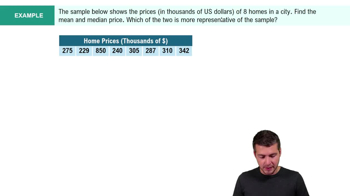
Comparing Mean vs. Median Example 2

Null Hypothesis

In the context of One-Way ANOVA, the null hypothesis posits that there are no differences in the means of the groups being compared. This serves as a baseline assumption that any observed differences are due to random variation rather than a true effect of the independent variable. If the ANOVA results indicate a significant difference, the null hypothesis can be rejected.
Recommended video:
Guided course
06:21
Step 1: Write Hypotheses

F-Statistic

The F-statistic is a ratio used in One-Way ANOVA that compares the variance between the group means to the variance within the groups. A higher F-statistic indicates a greater disparity between group means relative to the variability within the groups, suggesting that at least one group mean is significantly different from the others. This statistic is crucial for determining the significance of the results.
Recommended video:
Guided course
05:53
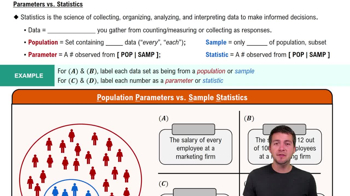
Parameters vs. Statistics
Related Practice
Textbook Question

In Exercises 1–4, use the following listed measured amounts of chest compression (mm) from car crash tests (from Data Set 35 “Car Data” in Appendix B). Also shown are the SPSS results from analysis of variance. Assume that we plan to use a 0.05 significance level to test the claim that the different car sizes have the same mean amount of chest compression.

P-VALUE If we use a 0.05 significance level in analysis of variance with the sample data given in Exercise 1, what is the P-value? What should we conclude? If the four populations have means that do not appear to be the same, does the analysis of variance test enable us to identify which populations have means that are significantly different?

21
views
Textbook Question

Sitting Heights The sitting height of a person is the vertical distance between the sitting surface and the top of the head. The following table lists sitting heights (mm) of randomly selected U.S. Army personnel collected as part of the ANSUR II study. Using the data with a 0.05 significance level, what do you conclude? Are the results as you would expect?

269
views
Textbook Question

In Exercises 5–16, use analysis of variance for the indicated test.


Triathlon Times Jeff Parent is a statistics instructor who participates in triathlons. Listed below are times (in minutes and seconds) he recorded while riding a bicycle for five stages through each mile of a 3-mile loop. Use a 0.05 significance level to test the claim that it takes the same time to ride each of the miles. Does one of the miles appear to have a hill?

122
views
Textbook Question

Pancake Experiment Listed below are ratings of pancakes made by experts (based on data from Minitab). Different pancakes were made with and without a supplement and with different amounts of whey. The results from two-way analysis of variance are shown. Use the displayed results and a 0.05 significance level. What do you conclude?

44
views
Textbook Question

Tukey Test A display of the Bonferroni test results from Table 12-1 (which is part of the Chapter Problem) is provided here. Shown on the top of the next page is the SPSS-generated display of results from the Tukey test using the same data. Compare the Tukey test results to those from the Bonferroni test.

32
views
Textbook Question

In Exercises 1–4, use the following listed measured amounts of chest compression (mm) from car crash tests (from Data Set 35 “Car Data” in Appendix B). Also shown are the SPSS results from analysis of variance. Assume that we plan to use a 0.05 significance level to test the claim that the different car sizes have the same mean amount of chest compression.


Why Not Test Two at a Time? Refer to the sample data given in Exercise 1. If we want to test for equality of the four means, why don’t we use the methods of Section 9-2 “Two Means: Independent Samples” for the following six separate hypothesis tests?


110
views