
Ch. 3 - Probability
Larson - Elementary Statistics: Picturing the World 8th Edition
Larson8th EditionElementary Statistics: Picturing the WorldISBN: 9780137493470Not the one you use?Change textbook
Chapter 3, Problem 3.4.12

In Exercises 7-14, perform the indicated calculation.
12. (10C7)/(14C7)

Verified step by step guidance
1
Step 1: Understand the problem. The problem involves calculating a ratio of combinations. Specifically, we need to compute \( \frac{{10C7}}{{14C7}} \), where \( nCk \) represents the number of combinations of \( k \) items chosen from \( n \) items.
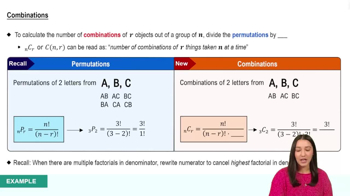
Step 2: Recall the formula for combinations. The formula for \( nCk \) is given by \( nCk = \frac{{n!}}{{k!(n-k)!}} \), where \( n! \) is the factorial of \( n \).
Step 3: Apply the formula to calculate \( 10C7 \). Substitute \( n = 10 \) and \( k = 7 \) into the formula: \( 10C7 = \frac{{10!}}{{7!(10-7)!}} = \frac{{10!}}{{7! \cdot 3!}} \).
Step 4: Apply the formula to calculate \( 14C7 \). Substitute \( n = 14 \) and \( k = 7 \) into the formula: \( 14C7 = \frac{{14!}}{{7!(14-7)!}} = \frac{{14!}}{{7! \cdot 7!}} \).
Step 5: Simplify the ratio \( \frac{{10C7}}{{14C7}} \). Substitute the expressions for \( 10C7 \) and \( 14C7 \) into the ratio and simplify by canceling common terms. This will give the final result.

Verified video answer for a similar problem:

This video solution was recommended by our tutors as helpful for the problem above.
Video duration:
4m
Was this helpful?

Key Concepts

Here are the essential concepts you must grasp in order to answer the question correctly.

Combinations

Combinations refer to the selection of items from a larger set where the order of selection does not matter. The notation 'nCr' represents the number of ways to choose 'r' items from 'n' items, calculated using the formula n! / (r!(n-r)!), where '!' denotes factorial. Understanding combinations is essential for solving problems involving groups or selections.
Recommended video:
05:22
Combinations

Factorial

A factorial, denoted as 'n!', is the product of all positive integers up to 'n'. For example, 5! = 5 × 4 × 3 × 2 × 1 = 120. Factorials are fundamental in combinatorial calculations, as they help determine the total arrangements or selections of items, making them crucial for understanding combinations.
Recommended video:
05:22
Combinations

Ratio of Combinations

The ratio of combinations compares two different combinations, providing insight into their relative sizes. In the expression (10C7)/(14C7), it calculates how many ways you can choose 7 items from 10 compared to choosing 7 from 14. This concept is useful in probability and statistics for understanding the likelihood of different outcomes.
Recommended video:
05:22
Combinations