Without using a calculator, decide whether each function value is positive or negative. (Hint: Consider the radian measures of the quadrantal angles, and remember that π ≈ 3.14.)
cos 6
Verified step by step guidance
1
First, recognize that the angle given is in radians: 6 radians.
Recall that one full rotation (circle) in radians is \(2\pi\), which is approximately \$6.28$ radians.
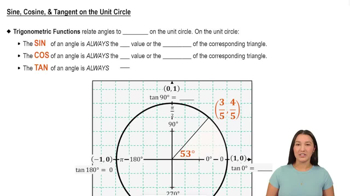
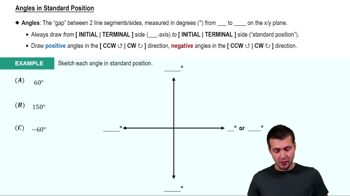
Since \$6$ radians is slightly less than \(2\pi\) radians, the angle is in the fourth quadrant of the unit circle (between \(\frac{3\pi}{2}\) and \(2\pi\)).
In the fourth quadrant, the cosine function (which corresponds to the x-coordinate on the unit circle) is positive.
Therefore, without calculating the exact value, we conclude that \(\cos 6\) is positive.
Verified video answer for a similar problem:
This video solution was recommended by our tutors as helpful for the problem above
Play a video:
0 Comments
Key Concepts
Here are the essential concepts you must grasp in order to answer the question correctly.
Radian Measure and Quadrantal Angles
Radian measure expresses angles based on the radius of a circle, where 2π radians equal 360°. Quadrantal angles are multiples of π/2 (90°), dividing the circle into four quadrants. Understanding where an angle lies relative to these helps determine the sign of trigonometric functions.
The unit circle defines sine and cosine values as coordinates of points on a circle of radius 1. The sign of cosine depends on the x-coordinate, which is positive in the first and fourth quadrants and negative in the second and third. Identifying the quadrant of the angle helps decide the sign of cosine.
To determine the sign of cos(6) without a calculator, approximate 6 radians relative to π (≈3.14). Since 6 is close to 2π (≈6.28), it lies just before completing a full circle, placing it in the fourth quadrant where cosine values are positive.