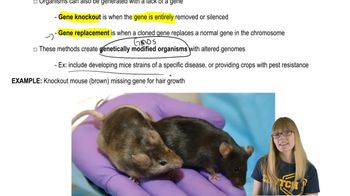
One complication of making a transgenic animal is that the transgene may integrate at random into the coding region, or the regulatory region, of an endogenous gene. What might be the consequences of such random integrations? How might this complicate genetic analysis of the transgene?
Table of contents
- 1. Introduction to Genetics51m
- 2. Mendel's Laws of Inheritance3h 37m
- 3. Extensions to Mendelian Inheritance2h 41m
- 4. Genetic Mapping and Linkage2h 28m
- 5. Genetics of Bacteria and Viruses1h 21m
- 6. Chromosomal Variation1h 48m
- 7. DNA and Chromosome Structure56m
- 8. DNA Replication1h 10m
- 9. Mitosis and Meiosis1h 34m
- 10. Transcription1h 0m
- 11. Translation58m
- 12. Gene Regulation in Prokaryotes1h 19m
- 13. Gene Regulation in Eukaryotes44m
- 14. Genetic Control of Development44m
- 15. Genomes and Genomics1h 50m
- 16. Transposable Elements47m
- 17. Mutation, Repair, and Recombination1h 6m
- 18. Molecular Genetic Tools19m
- 19. Cancer Genetics29m
- 20. Quantitative Genetics1h 26m
- 21. Population Genetics50m
- 22. Evolutionary Genetics29m
15. Genomes and Genomics
Genomics and Human Medicine
Problem 26
Textbook Question
What techniques can scientists use to determine if a particular transgene has been integrated into the genome of an organism?
Verified step by step guidance1
Understand that a transgene is a gene that has been transferred from one organism into the genome of another, and scientists need to confirm its presence and integration into the host genome.
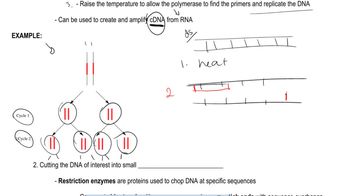
Use Polymerase Chain Reaction (PCR) to amplify specific DNA sequences of the transgene. Design primers that match the transgene sequence and perform PCR on the organism's DNA to check for the presence of the transgene.
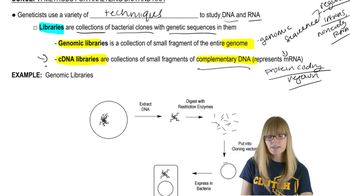
Perform Southern blot analysis to detect the integration and copy number of the transgene. This involves digesting genomic DNA with restriction enzymes, separating fragments by gel electrophoresis, transferring them to a membrane, and hybridizing with a labeled probe specific to the transgene.
Use Fluorescence In Situ Hybridization (FISH) to visualize the physical location of the transgene on chromosomes. This technique uses fluorescently labeled probes that bind to the transgene sequence in chromosome spreads.
Consider using quantitative PCR (qPCR) or digital droplet PCR to estimate the copy number of the transgene, or sequencing methods to confirm the exact integration site and sequence integrity.
Verified video answer for a similar problem:This video solution was recommended by our tutors as helpful for the problem above
Video duration:
2mPlay a video:
Was this helpful?
Key Concepts
Here are the essential concepts you must grasp in order to answer the question correctly.
Transgene Integration
Transgene integration refers to the insertion of foreign DNA into an organism's genome. Understanding this process is essential because it determines whether the introduced gene is stably incorporated and can be inherited by subsequent generations.
Recommended video:
Guided course
Transgenic Organisms and Gene Therapy
Polymerase Chain Reaction (PCR)
PCR is a molecular technique used to amplify specific DNA sequences. Scientists use PCR to detect the presence of a transgene by designing primers that target the inserted gene, allowing rapid and sensitive identification of transgene integration.
Recommended video:
Guided course
Genetic Cloning
Southern Blotting
Southern blotting is a method for detecting specific DNA sequences within a genome. It involves DNA digestion, gel electrophoresis, transfer to a membrane, and hybridization with a labeled probe, enabling confirmation of transgene integration and copy number.
Recommended video:
Guided course
Methods for Analyzing DNA and RNA
Watch next
Master Human Genome Composition with a bite sized video explanation from Kylia
Start learningRelated Videos
Related Practice
Textbook Question
524
views
