When the cloned cat Carbon Copy (CC) was born, she had black patches and white patches, but completely lacked any orange patches. The knowledgeable students of genetics were not surprised at this outcome. Starting with the somatic ovarian cell used as the source of the nucleus in the cloning process, explain how this outcome occurred.
Table of contents
- 1. Introduction to Genetics51m
- 2. Mendel's Laws of Inheritance3h 37m
- 3. Extensions to Mendelian Inheritance2h 41m
- 4. Genetic Mapping and Linkage2h 28m
- 5. Genetics of Bacteria and Viruses1h 21m
- 6. Chromosomal Variation1h 48m
- 7. DNA and Chromosome Structure56m
- 8. DNA Replication1h 10m
- 9. Mitosis and Meiosis1h 34m
- 10. Transcription1h 0m
- 11. Translation58m
- 12. Gene Regulation in Prokaryotes1h 19m
- 13. Gene Regulation in Eukaryotes44m
- 14. Genetic Control of Development44m
- 15. Genomes and Genomics1h 50m
- 16. Transposable Elements47m
- 17. Mutation, Repair, and Recombination1h 6m
- 18. Molecular Genetic Tools19m
- 19. Cancer Genetics29m
- 20. Quantitative Genetics1h 26m
- 21. Population Genetics50m
- 22. Evolutionary Genetics29m
2. Mendel's Laws of Inheritance
Sex-Linked Genes
Problem 28c
Textbook Question
While vermilion is X-linked in Drosophila and causes the eye color to be bright red, brown is an autosomal recessive mutation that causes the eye to be brown. Flies carrying both mutations lose all pigmentation and are white-eyed. Predict the F₁ and F₂ results of the following crosses:
white females x wild-type males
Verified step by step guidance1
Step 1: Define the alleles and their inheritance patterns. Vermilion (v) is X-linked, with the wild-type allele (V) dominant over vermilion (v). Brown (b) is autosomal recessive, with the wild-type allele (B) dominant over brown (b). The white-eyed phenotype occurs when both mutations (v and b) are present together, resulting in loss of pigmentation.
Step 2: Determine the genotypes of the parental flies. The white-eyed females must be homozygous for brown (bb) and carry the vermilion mutation on both X chromosomes (X\^v X\^v). The wild-type males have normal alleles: X\^V Y for the X-linked gene and BB or Bb for the autosomal gene (assuming homozygous dominant BB for simplicity).
Step 3: Predict the F₁ genotypes by performing the cross. For the X-linked gene, females contribute X\^v, males contribute X\^V or Y. For the autosomal gene, females contribute b, males contribute B. Write out the possible combinations of alleles for the F₁ offspring, considering sex and autosomal genotype.
Step 4: Determine the F₁ phenotypes based on the genotypes. Remember that vermilion is X-linked recessive, so only males with X\^v Y will show vermilion eyes, and brown is recessive, so only bb individuals show brown eyes. Also, individuals with both mutations (v and b) will be white-eyed.
Step 5: Predict the F₂ generation by crossing F₁ individuals. Set up a Punnett square for both the X-linked and autosomal genes, considering the genotypes of F₁ males and females. Calculate the expected phenotypic ratios for the F₂ offspring, including wild-type, vermilion, brown, and white-eyed flies.
Verified video answer for a similar problem:This video solution was recommended by our tutors as helpful for the problem above
Video duration:
2mPlay a video:
Was this helpful?
Key Concepts
Here are the essential concepts you must grasp in order to answer the question correctly.
X-linked Inheritance
X-linked inheritance refers to genes located on the X chromosome. In Drosophila, males have one X and one Y chromosome, so a single recessive mutation on the X chromosome will express the trait in males. Females have two X chromosomes, so they can be carriers if heterozygous. This pattern affects the distribution of traits like the vermilion eye color.
Recommended video:
Guided course
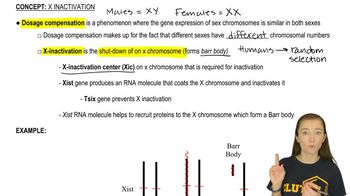
X-Inactivation
Autosomal Recessive Inheritance
Autosomal recessive inheritance involves genes on non-sex chromosomes where two copies of the recessive allele are needed to express the trait. Brown eye color in Drosophila is caused by such a mutation. Heterozygous individuals are carriers without showing the phenotype, influencing the expected ratios in offspring.
Recommended video:
Guided course
Autosomal Pedigrees
Epistasis and Interaction of Multiple Genes
Epistasis occurs when one gene masks or modifies the expression of another. In this case, the combination of vermilion (X-linked) and brown (autosomal recessive) mutations results in white eyes due to loss of pigmentation. Understanding gene interactions is essential to predict phenotypic ratios in F₁ and F₂ generations.
Recommended video:
Guided course
Interacting Genes Overview
Related Videos
Related Practice
Textbook Question
490
views
