In humans that are XX/XO mosaics, the phenotype is highly variable, ranging from females who have classic Turner syndrome symptoms to females who are essentially normal. Likewise, XY/XO mosaics have phenotypes that range from Turner syndrome females to essentially normal males. How can the wide range of phenotypes be explained for these sex-chromosome mosaics?
Table of contents
- 1. Introduction to Genetics51m
- 2. Mendel's Laws of Inheritance3h 37m
- 3. Extensions to Mendelian Inheritance2h 41m
- 4. Genetic Mapping and Linkage2h 28m
- 5. Genetics of Bacteria and Viruses1h 21m
- 6. Chromosomal Variation1h 48m
- 7. DNA and Chromosome Structure56m
- 8. DNA Replication1h 10m
- 9. Mitosis and Meiosis1h 34m
- 10. Transcription1h 0m
- 11. Translation58m
- 12. Gene Regulation in Prokaryotes1h 19m
- 13. Gene Regulation in Eukaryotes44m
- 14. Genetic Control of Development44m
- 15. Genomes and Genomics1h 50m
- 16. Transposable Elements47m
- 17. Mutation, Repair, and Recombination1h 6m
- 18. Molecular Genetic Tools19m
- 19. Cancer Genetics29m
- 20. Quantitative Genetics1h 26m
- 21. Population Genetics50m
- 22. Evolutionary Genetics29m
6. Chromosomal Variation
Chromosomal Mutations: Aneuploidy
Problem 27c
Textbook Question
A boy with Klinefelter syndrome (47,XXY) is born to a mother who is phenotypically normal and a father who has the X-linked skin condition called anhidrotic ectodermal dysplasia. The mother's skin is completely normal with no signs of the skin abnormality. In contrast, her son has patches of normal skin and patches of abnormal skin.
Using the appropriate genetic terminology, explain the son's skin phenotype.
Verified step by step guidance1
Step 1: Identify the inheritance pattern of the skin condition. Since the father has anhidrotic ectodermal dysplasia, which is an X-linked condition, the gene responsible is located on the X chromosome. The father’s genotype for this gene is affected on his single X chromosome (X^aY), where X^a represents the affected allele.
Step 2: Consider the son's karyotype and genotype. The son has Klinefelter syndrome (47,XXY), meaning he has two X chromosomes and one Y chromosome. He inherits one X chromosome from his mother and one X chromosome from his father, plus a Y chromosome from his father.
Step 3: Analyze the mother's genotype. The mother is phenotypically normal with no signs of the skin abnormality, indicating she is likely homozygous normal (X^N X^N) or a carrier (X^N X^a) without symptoms due to X-inactivation.
Step 4: Explain the mosaic skin phenotype in the son. Because the son has two X chromosomes, one of which carries the affected allele from the father (X^a), and one normal X chromosome from the mother (X^N), random X-inactivation (lyonization) occurs in his cells. This leads to some cells expressing the normal allele and others expressing the affected allele, resulting in patches of normal and abnormal skin.
Step 5: Summarize using genetic terminology. The son's skin phenotype is an example of X-linked mosaicism due to random X-inactivation in a 47,XXY individual, causing a patchy distribution of the X-linked skin condition.
Verified video answer for a similar problem:This video solution was recommended by our tutors as helpful for the problem above
Video duration:
2mPlay a video:
Was this helpful?
Key Concepts
Here are the essential concepts you must grasp in order to answer the question correctly.
Klinefelter Syndrome (47,XXY)
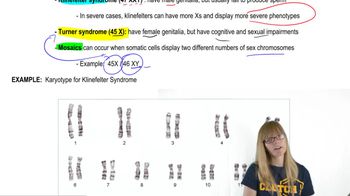
Klinefelter syndrome is a chromosomal condition where a male has an extra X chromosome, resulting in a 47,XXY karyotype. This affects sexual development and can influence the expression of X-linked traits, as males with two X chromosomes may show mosaicism or variable expression of X-linked genes.
Recommended video:
Guided course
Human Sex Chromosomes
X-linked Inheritance and Mosaicism
X-linked inheritance involves genes located on the X chromosome. In males (XY), a single mutated gene on the X chromosome causes the trait to be expressed. In individuals with more than one X chromosome, such as 47,XXY males, random X-chromosome inactivation leads to mosaicism, where some cells express the normal allele and others the mutated allele.
Recommended video:
Guided course
X-Inactivation
X-Chromosome Inactivation (Lyonization)
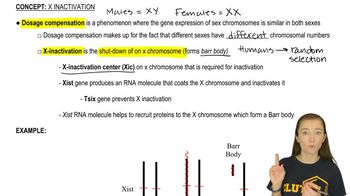
X-chromosome inactivation is a process in females and individuals with multiple X chromosomes where one X chromosome is randomly silenced in each cell. This results in a mosaic pattern of gene expression, explaining why the son has patches of normal and abnormal skin, as some cells express the normal X and others the mutated X.
Recommended video:
Guided course
X-Inactivation
Related Videos
Related Practice
Textbook Question
637
views
