A plant breeder would like to develop a seedless variety of cucumber from two existing lines. Line A is a tetraploid line, and line B is a diploid line. Describe the breeding strategy that will produce a seedless line, and support your strategy by describing the results of crosses.
Table of contents
- 1. Introduction to Genetics51m
- 2. Mendel's Laws of Inheritance3h 37m
- 3. Extensions to Mendelian Inheritance2h 41m
- 4. Genetic Mapping and Linkage2h 28m
- 5. Genetics of Bacteria and Viruses1h 21m
- 6. Chromosomal Variation1h 48m
- 7. DNA and Chromosome Structure56m
- 8. DNA Replication1h 10m
- 9. Mitosis and Meiosis1h 34m
- 10. Transcription1h 0m
- 11. Translation58m
- 12. Gene Regulation in Prokaryotes1h 19m
- 13. Gene Regulation in Eukaryotes44m
- 14. Genetic Control of Development44m
- 15. Genomes and Genomics1h 50m
- 16. Transposable Elements47m
- 17. Mutation, Repair, and Recombination1h 6m
- 18. Molecular Genetic Tools19m
- 19. Cancer Genetics29m
- 20. Quantitative Genetics1h 26m
- 21. Population Genetics50m
- 22. Evolutionary Genetics29m
6. Chromosomal Variation
Chromosomal Mutations: Aneuploidy
Problem 27b
Textbook Question
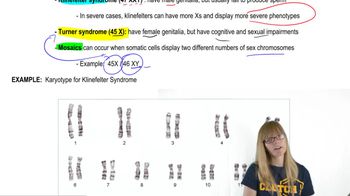
A boy with Klinefelter syndrome (47,XXY) is born to a mother who is phenotypically normal and a father who has the X-linked skin condition called anhidrotic ectodermal dysplasia. The mother's skin is completely normal with no signs of the skin abnormality. In contrast, her son has patches of normal skin and patches of abnormal skin.
Using the appropriate genetic terminology, describe the meiotic mistake that occurred. Be sure to indicate in which division the mistake occurred.
Verified step by step guidance1
Step 1: Understand the genetic background of the problem. The boy has Klinefelter syndrome (47,XXY), meaning he has two X chromosomes and one Y chromosome. The mother is phenotypically normal and does not show the X-linked skin condition, while the father has the X-linked condition (anhidrotic ectodermal dysplasia).
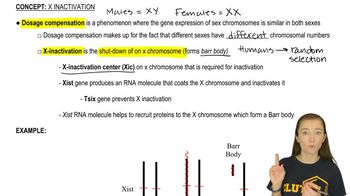
Step 2: Recognize that the son’s phenotype shows patches of normal and abnormal skin, which suggests mosaicism due to X-chromosome inactivation (lyonization). This occurs because females (XX) randomly inactivate one X chromosome in each cell, leading to a mosaic pattern if one X carries a mutation.
Step 3: Since the son has two X chromosomes, one from the mother and one from the father, and the father has the mutant X, the presence of both normal and abnormal skin patches indicates that the son inherited both X chromosomes and that X-inactivation is causing the mosaic phenotype.
Step 4: Identify the meiotic error: the mother must have contributed two X chromosomes instead of one, indicating nondisjunction during meiosis. Determine whether this nondisjunction occurred in meiosis I or meiosis II by considering the genetic consequences of each division.
Step 5: Conclude that the nondisjunction likely occurred during maternal meiosis I, where homologous chromosomes fail to separate, resulting in an egg with two X chromosomes. Fertilization with a Y-bearing sperm from the father leads to a 47,XXY karyotype in the son.
Verified video answer for a similar problem:This video solution was recommended by our tutors as helpful for the problem above
Video duration:
2mPlay a video:
Was this helpful?
Key Concepts
Here are the essential concepts you must grasp in order to answer the question correctly.
Klinefelter Syndrome (47,XXY)
Klinefelter syndrome is a chromosomal condition where a male has an extra X chromosome, resulting in a 47,XXY karyotype. It arises due to nondisjunction during meiosis, leading to an abnormal number of sex chromosomes. This syndrome affects male development and is key to understanding the genetic background of the boy in the question.
Recommended video:
Guided course
Human Sex Chromosomes
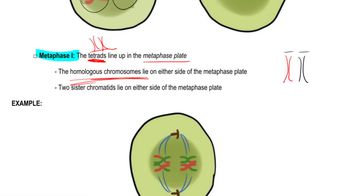
Nondisjunction in Meiosis I and II
Nondisjunction is the failure of homologous chromosomes or sister chromatids to separate properly during meiosis. If it occurs in meiosis I, homologous chromosomes fail to separate; if in meiosis II, sister chromatids fail to separate. Identifying the division where nondisjunction happened explains the origin of abnormal chromosome numbers in gametes.
Recommended video:
Guided course
Meiosis Steps
X-linked Inheritance and Mosaicism due to X-inactivation
X-linked conditions are caused by mutations on the X chromosome. Females have two X chromosomes and undergo X-inactivation, randomly silencing one X in each cell, leading to mosaic expression. The boy’s patchy skin reflects mosaicism from inheriting two X chromosomes with different alleles, explaining the mixed normal and abnormal skin patches.
Recommended video:
Guided course
X-Inactivation
Related Videos
Related Practice
Textbook Question
472
views
