Horse diploid cells contain 64 chromosomes (2n=64). How many chromosomes will be present in primary oocyte cells?
Table of contents
- 1. Introduction to Genetics51m
- 2. Mendel's Laws of Inheritance3h 37m
- 3. Extensions to Mendelian Inheritance2h 41m
- 4. Genetic Mapping and Linkage2h 28m
- 5. Genetics of Bacteria and Viruses1h 21m
- 6. Chromosomal Variation1h 48m
- 7. DNA and Chromosome Structure56m
- 8. DNA Replication1h 10m
- 9. Mitosis and Meiosis1h 34m
- 10. Transcription1h 0m
- 11. Translation58m
- 12. Gene Regulation in Prokaryotes1h 19m
- 13. Gene Regulation in Eukaryotes44m
- 14. Genetic Control of Development44m
- 15. Genomes and Genomics1h 50m
- 16. Transposable Elements47m
- 17. Mutation, Repair, and Recombination1h 6m
- 18. Molecular Genetic Tools19m
- 19. Cancer Genetics29m
- 20. Quantitative Genetics1h 26m
- 21. Population Genetics50m
- 22. Evolutionary Genetics29m
9. Mitosis and Meiosis
Development of Animal Gametes
Problem 17
Textbook Question
During oogenesis in an animal species with a haploid number of 6, one dyad undergoes nondisjunction during meiosis II. Following the second meiotic division, this dyad ends up intact in the ovum. How many chromosomes are present in
(a) the mature ovum and
(b) the second polar body?
(c) Following fertilization by a normal sperm, what chromosome condition is created?
Verified step by step guidance1
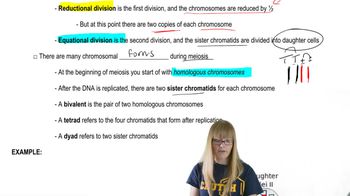
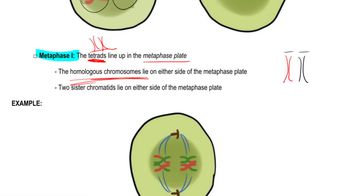
Step 1: Understand the normal chromosome number and meiotic divisions. The species has a haploid number (n) of 6, meaning each gamete normally has 6 chromosomes after meiosis. Meiosis I separates homologous chromosomes, and meiosis II separates sister chromatids.
Step 2: Analyze the nondisjunction event during meiosis II. Nondisjunction means the sister chromatids of one dyad fail to separate. As a result, one daughter cell (the ovum) receives both chromatids (the intact dyad), while the other (the second polar body) receives none from that dyad.
Step 3: Determine the chromosome number in the mature ovum. Since the ovum normally has 6 chromosomes, but here it receives an extra chromatid from the nondisjoined dyad, calculate the total chromosomes by adding the extra chromatid to the normal haploid number.
Step 4: Determine the chromosome number in the second polar body. Because the sister chromatids failed to separate, the second polar body will lack the chromatids from that dyad, so subtract those from the normal haploid number to find its chromosome count.
Step 5: Assess the chromosome condition after fertilization. The ovum with the abnormal chromosome number is fertilized by a normal sperm with 6 chromosomes. Combine these to determine the zygote's chromosome number and describe the resulting aneuploid condition (e.g., trisomy or monosomy).
Verified video answer for a similar problem:This video solution was recommended by our tutors as helpful for the problem above
Video duration:
1mPlay a video:
Was this helpful?
Key Concepts
Here are the essential concepts you must grasp in order to answer the question correctly.
Meiosis and Chromosome Number
Meiosis is a two-step cell division process that reduces the chromosome number by half, producing haploid gametes from diploid cells. In species with a haploid number of 6, each gamete normally contains 6 chromosomes. Understanding the stages of meiosis and how chromosomes segregate is essential to determine chromosome numbers in gametes.
Recommended video:
Guided course
Meiosis Overview
Nondisjunction During Meiosis II
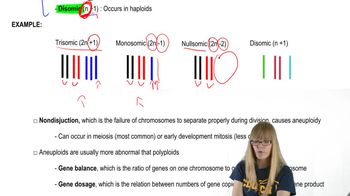
Nondisjunction is the failure of sister chromatids to separate during meiosis II, resulting in one gamete with an extra chromosome and another missing that chromosome. This error leads to abnormal chromosome numbers in the resulting cells, affecting the genetic content of the ovum and polar bodies.
Recommended video:
Guided course
Meiosis Steps
Fertilization and Aneuploidy
Fertilization combines the haploid gametes from each parent to restore the diploid chromosome number. When a gamete with an abnormal chromosome number (due to nondisjunction) fuses with a normal gamete, the resulting zygote exhibits aneuploidy, a condition with an abnormal number of chromosomes, which can cause developmental abnormalities.
Recommended video:
Guided course
Aneuploidy
Related Videos
Related Practice
Multiple Choice
733
views
1
rank