Horse diploid cells contain 64 chromosomes (2n=64). How many chromosomes will be present in spermatids cells?
Table of contents
- 1. Introduction to Genetics51m
- 2. Mendel's Laws of Inheritance3h 37m
- 3. Extensions to Mendelian Inheritance2h 41m
- 4. Genetic Mapping and Linkage2h 28m
- 5. Genetics of Bacteria and Viruses1h 21m
- 6. Chromosomal Variation1h 48m
- 7. DNA and Chromosome Structure56m
- 8. DNA Replication1h 10m
- 9. Mitosis and Meiosis1h 34m
- 10. Transcription1h 0m
- 11. Translation58m
- 12. Gene Regulation in Prokaryotes1h 19m
- 13. Gene Regulation in Eukaryotes44m
- 14. Genetic Control of Development44m
- 15. Genomes and Genomics1h 50m
- 16. Transposable Elements47m
- 17. Mutation, Repair, and Recombination1h 6m
- 18. Molecular Genetic Tools19m
- 19. Cancer Genetics29m
- 20. Quantitative Genetics1h 26m
- 21. Population Genetics50m
- 22. Evolutionary Genetics29m
9. Mitosis and Meiosis
Development of Animal Gametes
Problem 18
Textbook Question
What is the probability that, in an organism with a haploid number of 10, a sperm will be formed that contains all 10 chromosomes whose centromeres were derived from maternal homologs?
Verified step by step guidance1
Understand that the organism has a haploid number of 10, meaning each gamete (sperm) will contain 10 chromosomes, one from each homologous pair.
Recognize that for each homologous chromosome pair, there are two possible centromere origins: maternal or paternal.
Since the question asks for the probability that all 10 chromosomes in the sperm have centromeres derived from the maternal homologs, consider that each chromosome pair independently contributes either the maternal or paternal centromere with equal probability (assuming no bias).
Calculate the probability for one chromosome to have the maternal centromere, which is \(\frac{1}{2}\), and then raise this probability to the power of 10 (the number of chromosome pairs) to find the combined probability for all chromosomes.
Express the final probability as \(\left(\frac{1}{2}\right)^{10}\), representing the chance that all 10 chromosomes in the sperm carry maternal centromeres.
Was this helpful?
Key Concepts
Here are the essential concepts you must grasp in order to answer the question correctly.
Haploid Number and Chromosome Composition
The haploid number represents the number of chromosomes in a gamete, which is half the diploid number. In this case, the organism has 10 chromosomes in its haploid set, meaning each sperm normally contains one chromosome from each homologous pair, either maternal or paternal.
Recommended video:
Guided course
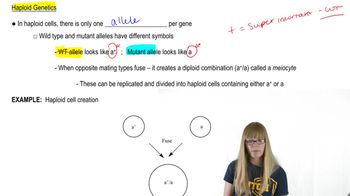
Haploid Genetics
Independent Assortment of Chromosomes
During meiosis, homologous chromosomes segregate independently, so each chromosome in a gamete has a 50% chance of being maternal or paternal in origin. This random assortment leads to genetic variation in gametes.
Recommended video:
Guided course
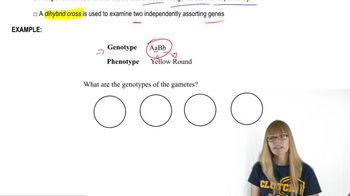
Gamete Genetics and Independent Assortment
Probability of Inheriting All Maternal Homologs
Since each chromosome has a 1/2 chance of being maternal, the probability that all 10 chromosomes in a sperm are maternal is (1/2)^10. This reflects the combined independent probabilities of inheriting each maternal chromosome.
Recommended video:
Guided course
Types of Maternal Inheritance
Related Videos
Related Practice
Multiple Choice
487
views
3
rank