Define plaque, lysogeny, and prophage.
Table of contents
- 1. Introduction to Genetics51m
- 2. Mendel's Laws of Inheritance3h 37m
- 3. Extensions to Mendelian Inheritance2h 41m
- 4. Genetic Mapping and Linkage2h 28m
- 5. Genetics of Bacteria and Viruses1h 21m
- 6. Chromosomal Variation1h 48m
- 7. DNA and Chromosome Structure56m
- 8. DNA Replication1h 10m
- 9. Mitosis and Meiosis1h 34m
- 10. Transcription1h 0m
- 11. Translation58m
- 12. Gene Regulation in Prokaryotes1h 19m
- 13. Gene Regulation in Eukaryotes44m
- 14. Genetic Control of Development44m
- 15. Genomes and Genomics1h 50m
- 16. Transposable Elements47m
- 17. Mutation, Repair, and Recombination1h 6m
- 18. Molecular Genetic Tools19m
- 19. Cancer Genetics29m
- 20. Quantitative Genetics1h 26m
- 21. Population Genetics50m
- 22. Evolutionary Genetics29m
5. Genetics of Bacteria and Viruses
Bacteriophage Genetics
Problem 15
Textbook Question
If a single bacteriophage infects one E. coli cell present on a lawn of bacteria and, upon lysis, yields 200 viable viruses, how many phages will exist in a single plaque if three more lytic cycles occur?
Verified step by step guidance1
Understand the problem: A single bacteriophage infects one E. coli cell and produces 200 new phages after one lytic cycle. We want to find the total number of phages after three additional lytic cycles, starting from this initial burst.
Identify the multiplication factor per lytic cycle: Each infected cell produces 200 phages, so each cycle multiplies the phage number by 200.
Express the total number of phages after multiple cycles using exponential growth: If \(N_0\) is the initial number of phages, and \(k\) is the number of cycles, then the total number of phages \(N\) after \(k\) cycles is given by the formula:
\(N = N_0 \times 200^k\)
Apply the formula to the problem: Here, the initial number of phages after the first lytic cycle is 200 (since one phage produced 200), and we want to find the number after three more cycles, so \(k=3\). Substitute these values into the formula.
Interpret the result: The final number represents the total number of phages in a single plaque after the initial infection and three additional lytic cycles.
Verified video answer for a similar problem:This video solution was recommended by our tutors as helpful for the problem above
Video duration:
1mPlay a video:
Was this helpful?
Key Concepts
Here are the essential concepts you must grasp in order to answer the question correctly.
Bacteriophage Life Cycle
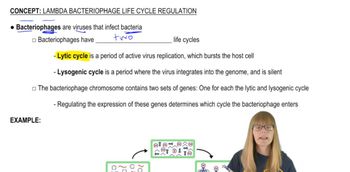
Bacteriophages infect bacterial cells and replicate inside them, eventually causing cell lysis to release new viral particles. The lytic cycle involves infection, replication, assembly, and lysis, producing multiple progeny phages from a single infected cell.
Recommended video:
Guided course
Bacteriophage Life Cycle
Plaque Formation on Bacterial Lawn
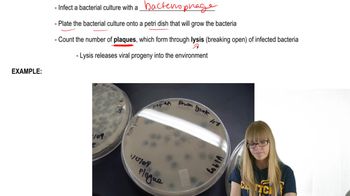
A plaque is a clear zone on a bacterial lawn where phages have lysed bacterial cells. Each plaque originates from a single phage infection and expands as successive lytic cycles infect neighboring cells, increasing the number of phages exponentially.
Recommended video:
Guided course
Plaques and Experiments
Exponential Growth in Lytic Cycles
During each lytic cycle, the number of phages multiplies by the burst size (number of phages produced per infected cell). After multiple cycles, the total phage count equals the initial burst size raised to the power of the number of cycles, demonstrating exponential growth.
Recommended video:
Guided course
Decision Between Lytic and Lysogenic Cycles
Watch next
Master Plaques and Experiments with a bite sized video explanation from Kylia
Start learningRelated Videos
Related Practice
Textbook Question
870
views