
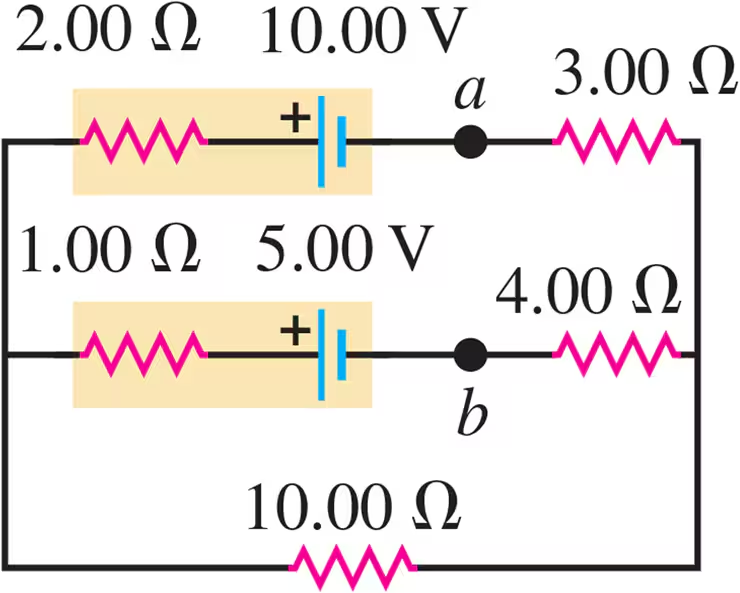
The 10.00 V battery in Fig. E26.28 is removed from the circuit and reinserted with the opposite polarity, so that its positive terminal is now next to point a. The rest of the circuit is as shown in the figure. Find the current in each branch.
Verified step by step guidance
1
Identify the components in the circuit, including resistors and batteries, and note their values and arrangement. The circuit consists of resistors and a battery with reversed polarity.
Apply Kirchhoff's loop rule, which states that the sum of the potential differences around any closed loop in a circuit must be zero. Write equations for each loop in the circuit, considering the reversed polarity of the battery.
Use Kirchhoff's junction rule, which states that the sum of currents entering a junction must equal the sum of currents leaving the junction. Write equations for each junction in the circuit.
Solve the system of equations obtained from the loop and junction rules to find the current in each branch. This may involve using algebraic techniques such as substitution or matrix methods.
Verify the solution by checking that the calculated currents satisfy both the loop and junction rules, ensuring that the sum of potential differences in each loop is zero and the sum of currents at each junction is balanced.
Verified video answer for a similar problem:
This video solution was recommended by our tutors as helpful for the problem above
Video duration:
13m
Play a video:
Was this helpful?
Key Concepts
Here are the essential concepts you must grasp in order to answer the question correctly.
Ohm's Law
Ohm's Law is fundamental for analyzing electrical circuits, stating that the current through a conductor between two points is directly proportional to the voltage across the two points and inversely proportional to the resistance. It is expressed as I = V/R, where I is the current, V is the voltage, and R is the resistance. This principle helps determine the current in each branch of the circuit.
Kirchhoff's Voltage Law (KVL) is essential for circuit analysis, stating that the sum of the electrical potential differences (voltage) around any closed network is zero. This law is used to set up equations based on the loop in the circuit, allowing for the calculation of unknown currents when the battery polarity is reversed.
Understanding the polarity of voltage sources is crucial when analyzing circuits, as reversing the polarity of a battery changes the direction of current flow. This affects the potential difference across components and requires reevaluation of the circuit using KVL and Ohm's Law to find the new current distribution in each branch.