
In 2004 astronomers reported the discovery of a large Jupiter-sized planet orbiting very close to the star HD 179949 (hence the term 'hot Jupiter'). The orbit was just 1/9 the distance of Mercury from our sun, and it takes the planet only 3.09 days to make one orbit (assumed to be circular). How fast (in km/s) is this planet moving?
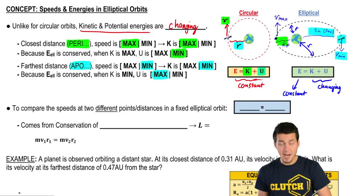
The dwarf planet Pluto has an elliptical orbit with a semimajor axis of 5.91 × 10¹² m and eccentricity 0.249. During Pluto's orbit around the sun, what are its closest and farthest distances from the sun?
Verified step by step guidance
Verified video answer for a similar problem:
Key Concepts
Elliptical Orbits
Semimajor Axis
Orbital Eccentricity
On October 15, 2001, a planet was discovered orbiting around the star HD 68988. Its orbital distance was measured to be 10.5 million kilometers from the center of the star, and its orbital period was estimated at 6.3 days. What is the mass of HD 68988? Express your answer in kilograms and in terms of our sun's mass.
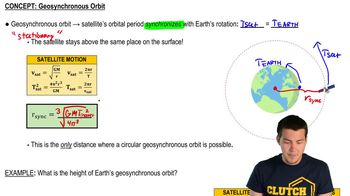
In its orbit each day, the International Space Station makes 15.65 revolutions around the earth. Assuming a circular orbit, how high is this satellite above the surface of the earth?
A uniform, spherical, 1000.0-kg shell has a radius of 5.00 m. Find the gravitational force this shell exerts on a 2.00-kg point mass placed at the following distances from the center of the shell: (i) 5.01 m, (ii) 4.99 m, (iii) 2.72 m.
The star Rho1 Cancri is 57 light-years from the earth and has a mass 0.85 times that of our sun. A planet has been detected in a circular orbit around Rho1 Cancri with an orbital radius equal to 0.11 times the radius of the earth's orbit around the sun. What are (a) the orbital speed and (b) the orbital period of the planet of Rho1 Cancri?
In March 2006, two small satellites were discovered orbiting Pluto, one at a distance of 48,000 km and the other at 64,000 km. Pluto already was known to have a large satellite Charon, orbiting at 19,600 km with an orbital period of 6.39 days. Assuming that the satellites do not affect each other, find the orbital periods of the two small satellites without using the mass of Pluto.
