
Ch 41: Quantum Mechanics II: Atomic Structure
Young & Freedman Calc - University Physics 14th Edition
Young & Freedman Calc14th EditionUniversity PhysicsISBN: 9780321973610Not the one you use?Change textbook
Chapter 41, Problem 24a

The hyperfine interaction in a hydrogen atom between the magnetic dipole moment of the proton and the spin magnetic dipole moment of the electron splits the ground level into two levels separated by 5.9×1065.9\(\times\)10^{-6} eV. Calculate the wavelength and frequency of the photon emitted when the atom makes a transition between these states, and compare your answer to the value given at the end of Section 41.541.5. In what part of the electromagnetic spectrum does this lie? Such photons are emitted by cold hydrogen clouds in interstellar space; by detecting these photons, astronomers can learn about the number and density of such clouds.

Verified step by step guidance
1
Step 1: Start by understanding the energy difference between the two levels, which is given as 5.9 × 10⁻⁶ eV. Convert this energy into joules using the conversion factor: 1 eV = 1.602 × 10⁻¹⁹ J. Use the formula: E (in joules) = E (in eV) × 1.602 × 10⁻¹⁹.
Step 2: Use the energy-wavelength relationship to calculate the wavelength of the photon emitted during the transition. The formula is: λ = hc / E, where h is Planck's constant (6.626 × 10⁻³⁴ J·s), c is the speed of light (3.00 × 10⁸ m/s), and E is the energy in joules.
Step 3: Calculate the frequency of the photon using the relationship between frequency, wavelength, and the speed of light: f = c / λ. Here, c is the speed of light and λ is the wavelength obtained in the previous step.
Step 4: Compare the calculated wavelength and frequency to the values given in Section 41.5 of your textbook. This step ensures consistency and helps verify the accuracy of your calculations.
Step 5: Determine the part of the electromagnetic spectrum where this wavelength lies. Use the electromagnetic spectrum classification to identify whether the wavelength corresponds to radio waves, microwaves, infrared, visible light, ultraviolet, X-rays, or gamma rays. In this case, the wavelength is expected to fall in the radio wave region, which is commonly associated with interstellar hydrogen emissions.

Verified video answer for a similar problem:

This video solution was recommended by our tutors as helpful for the problem above.
Video duration:
8m
Was this helpful?

Key Concepts

Here are the essential concepts you must grasp in order to answer the question correctly.

Energy-Wavelength-Frequency Relationship

The energy of a photon is directly related to its frequency and inversely related to its wavelength, described by the equations E = hf and c = λf, where E is energy, h is Planck's constant, f is frequency, c is the speed of light, and λ is wavelength. This relationship is crucial for calculating the wavelength and frequency of photons emitted during atomic transitions.
Recommended video:
Guided course
03:43
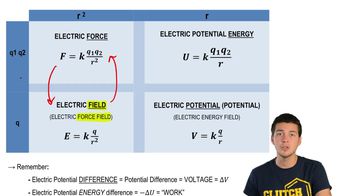
Relationships Between Force, Field, Energy, Potential

Photon Emission in Atomic Transitions

When an electron in an atom transitions between energy levels, it emits or absorbs a photon whose energy corresponds to the difference between those levels. In the case of hydrogen, the hyperfine interaction causes a small energy split, leading to the emission of photons in the microwave region of the electromagnetic spectrum when the atom transitions between these split states.
Recommended video:
Guided course
01:06
Charge of Atom

Electromagnetic Spectrum

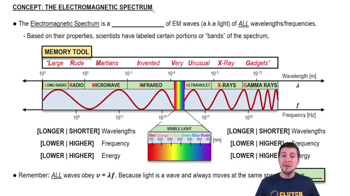
The electromagnetic spectrum encompasses all types of electromagnetic radiation, ranging from radio waves to gamma rays, categorized by wavelength or frequency. The specific part of the spectrum where the emitted photons from hydrogen transitions lie can provide insights into astronomical phenomena, such as the presence and density of cold hydrogen clouds in interstellar space.
Recommended video:
Guided course
06:06
The Electromagnetic Spectrum
Related Practice
Textbook Question

(a) If you treat an electron as a classical spherical object with a radius of 1.0×10171.0\(\times\)10^{-17} m, what angular speed is necessary to produce a spin angular momentum of magnitude 34h\(\sqrt{\frac34}\)h?

(b) Use v=rωv=r\(\omega\) and the result of part (a) to calculate the speed vv of a point at the electron's equator. What does your result suggest about the validity of this model?

1432
views
Textbook Question

The 5s5s electron in rubidium (Rb) sees an effective charge of 2.771e2.771e. Calculate the ionization energy of this electron.

1924
views
Textbook Question

A hydrogen atom undergoes a transition from a 2p2p state to the 1s1s ground state. In the absence of a magnetic field, the energy of the photon emitted is 122122 nm. The atom is then placed in a strong magnetic field in the zz-direction. Ignore spin effects; consider only the interaction of the magnetic field with the atom's orbital magnetic moment. How many different photon wavelengths are observed for the 2p1s2p\(\rightarrow\)1s transition? What are the mlm_l values for the initial and final states for the transition that leads to each photon wavelength?

2089
views
Textbook Question

A hydrogen atom in the 5g5g state is placed in a magnetic field of 0.6000.600 T that is in the zz-direction. Into how many levels is this state split by the interaction of the atom's orbital magnetic dipole moment with the magnetic field?

1532
views
Textbook Question

A hydrogen atom in a particular orbital angular momentum state is found to have jj quantum numbers 72\(\frac\)72 and 92\(\frac\)92. If n=5n = 5, what is the energy difference between the j=72j=\(\frac\)72 and j=92j=\(\frac\)92 levels?

1331
views
Textbook Question

Calculate the energy difference between the ms=12m_{s}=\(\frac\)12 ('spin up') and ms=12m_{s}=-\(\frac\)12 ('spin down') levels of a hydrogen atom in the 1s1s state when it is placed in a 1.451.45 T magnetic field in the negative zz-direction. Which level, ms=12m_{s}=\(\frac\)12 or ms=12m_{s}=-\(\frac\)12, has the lower energy?

2228
views