A typical small flashlight contains two batteries, each having an emf of 1.5 V, connected in series with a bulb having resistance 17 Ω. If the batteries last for 5.0 h, what is the total energy delivered to the bulb?
Ch 25: Current, Resistance, and EMF
Young & Freedman Calc14th EditionUniversity PhysicsISBN: 9780321973610Not the one you use?Change textbook
Chapter 25, Problem 49
Pure silicon at room temperature contains approximately 1.0 × 10¹⁶ free electrons per cubic meter. (a) Referring to Table 25.1, calculate the mean free time t for silicon at room temperature. (b) Your answer in part (a) is much greater than the mean free time for copper given in Example 25.11. Why, then, does pure silicon have such a high resistivity compared to copper?
Verified step by step guidance1
Step 1: Understand the concept of mean free time (τ). It is the average time between collisions of electrons as they move through a material. This is related to the material's resistivity and electron mobility.
Step 2: Use the formula for mean free time τ, which is given by τ = (m * μ) / (e * n), where m is the electron mass, μ is the electron mobility, e is the electron charge, and n is the number of free electrons per unit volume.
Step 3: Refer to Table 25.1 to find the electron mobility (μ) for silicon at room temperature. This value is necessary to calculate τ using the formula from Step 2.
Step 4: Calculate τ using the values obtained: m = 9.11 * 10^-31 kg (electron mass), e = 1.6 * 10^-19 C (electron charge), n = 1.0 * 10^16 m^-3 (free electrons per cubic meter), and μ from Table 25.1.
Step 5: Discuss why pure silicon has higher resistivity compared to copper. Silicon is a semiconductor with fewer free electrons and lower electron mobility compared to metals like copper, which have a high density of free electrons and high mobility, leading to lower resistivity.

Verified video answer for a similar problem:
This video solution was recommended by our tutors as helpful for the problem above.
Video duration:
9mWas this helpful?
Key Concepts
Here are the essential concepts you must grasp in order to answer the question correctly.
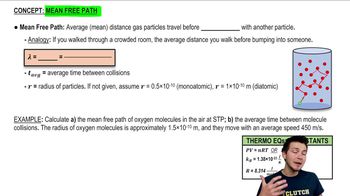
Mean Free Time
Mean free time is the average time between successive collisions of electrons as they move through a material. It is a crucial factor in determining the electrical conductivity of a material, as longer mean free times typically lead to higher conductivity. Calculating mean free time involves understanding the electron density and the scattering mechanisms within the material.
Recommended video:
Guided course
Mean Free Path
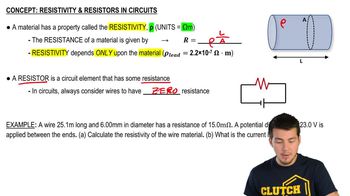
Resistivity
Resistivity is a measure of how strongly a material opposes the flow of electric current. It is influenced by factors such as electron mobility and density. Silicon's high resistivity compared to copper is due to its lower electron mobility and higher band gap, which restricts the flow of electrons, making it less conductive despite having a longer mean free time.
Recommended video:
Guided course
Resistivity & Resistors in Circuits
Band Gap
The band gap is the energy difference between the valence band and the conduction band in a semiconductor. It determines the number of charge carriers available for conduction. Silicon has a significant band gap, which limits the number of free electrons at room temperature, contributing to its higher resistivity compared to metals like copper, which have overlapping bands and more free electrons.
Recommended video:
Guided course
The Electromagnetic Spectrum
Related Practice
Textbook Question
1679
views
Textbook Question
A typical small flashlight contains two batteries, each having an emf of 1.5 V, connected in series with a bulb having resistance 17 Ω. The resistance of real batteries increases as they run down. If the initial internal resistance is negligible, what is the combined internal resistance of both batteries when the power to the bulb has decreased to half its initial value?
195
views
Textbook Question
A typical small flashlight contains two batteries, each having an emf of 1.5 V, connected in series with a bulb having resistance 17 Ω. If the internal resistance of the batteries is negligible, what power is delivered to the bulb?
1994
views