Ch 26: Potential and Field
Knight Calc - Physics for Scientists and Engineers 5th Edition
Knight Calc5th EditionPhysics for Scientists and EngineersISBN: 9780137344796Not the one you use?Change textbook
Chapter 26, Problem 68b

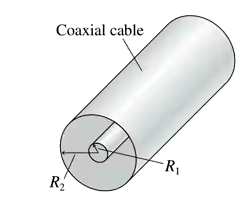
High-frequency signals are often transmitted along a coaxial cable, such as the one shown in FIGURE P26.68. For example, the cable TV hookup coming into your home is a coaxial cable. The signal is carried on a wire of radius R1 while the outer conductor of radius R2 is grounded (i.e., at V=0 V). An insulating material fills the space between them, and an insulating plastic coating goes around the outside. Evaluate the capacitance per meter of a cable having R1=0.50 mm and R2=3.0 mm.
Diagram of a coaxial cable showing inner radius R1 and outer radius R2, illustrating its structure for capacitance evaluation.

Verified step by step guidance
1
Step 1: Recognize that the capacitance per unit length of a coaxial cable can be calculated using the formula for the capacitance of a cylindrical capacitor: \( C' = \frac{2 \pi \varepsilon}{\ln(R_2 / R_1)} \), where \( \varepsilon \) is the permittivity of the insulating material, \( R_1 \) is the radius of the inner conductor, and \( R_2 \) is the radius of the outer conductor.
Step 2: Convert the given radii \( R_1 = 0.50 \, \text{mm} \) and \( R_2 = 3.0 \, \text{mm} \) into meters for consistency in SI units. This gives \( R_1 = 0.0005 \, \text{m} \) and \( R_2 = 0.003 \, \(\text{m}\).
Step 3: Identify the permittivity \( \varepsilon \) of the insulating material. If the problem does not specify the material, assume \( \varepsilon = \varepsilon_0 \), the permittivity of free space, which is \( \varepsilon_0 = 8.85 \times 10^{-12} \, \text{F/m} \).
Step 4: Substitute the values of \( \varepsilon \), \( R_1 \), and \( R_2 \) into the formula \( C' = \frac{2 \pi \varepsilon}{\ln(R_2 / R_1)} \). Ensure that the logarithmic term \( \ln(R_2 / R_1) \) is calculated using the natural logarithm.
Step 5: Simplify the expression to find the capacitance per meter \( C' \). The result will be in units of farads per meter (F/m).

Verified video answer for a similar problem:

This video solution was recommended by our tutors as helpful for the problem above.
Was this helpful?

Key Concepts

Here are the essential concepts you must grasp in order to answer the question correctly.

Capacitance

Capacitance is the ability of a system to store electric charge per unit voltage. It is defined as the ratio of the electric charge stored on a conductor to the potential difference across it. In coaxial cables, capacitance is influenced by the geometry of the conductors and the dielectric material between them, which affects how much charge can be stored.
Recommended video:
Guided course
08:02
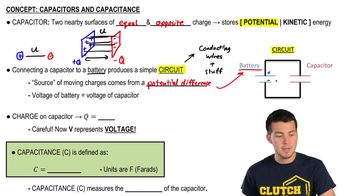
Capacitors & Capacitance (Intro)

Coaxial Cable Structure

A coaxial cable consists of two concentric conductors: an inner conductor with radius R1 and an outer conductor with radius R2. The space between these conductors is filled with an insulating material, which serves as a dielectric. This structure allows for efficient transmission of high-frequency signals while minimizing interference and signal loss.
Recommended video:
Guided course
03:25
Multiple Cables on a Loudspeaker

Dielectric Material

Dielectric materials are insulators that can be polarized by an electric field, which enhances the capacitance of a capacitor. In coaxial cables, the dielectric material between the inner and outer conductors affects the cable's capacitance and signal transmission characteristics. The choice of dielectric material can influence the cable's performance, including its bandwidth and attenuation.
Recommended video:
Guided course
06:25
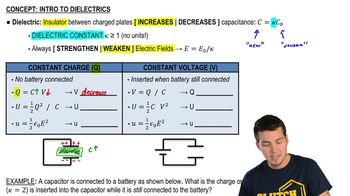
Intro To Dielectrics
Related Practice
Textbook Question

Derive Equation 26.33 for the induced surface charge density on the dielectric in a capacitor.

108
views

Textbook Question

A vacuum-insulated parallel-plate capacitor with plate separation d has capacitance C0. What is the capacitance if an insulator with dielectric constant κ and thickness d/2 is slipped between the electrodes without changing the plate separation?

93
views
Textbook Question

An isolated 5.0 μF parallel-plate capacitor has 4.0 mC of charge. An external force changes the distance between the electrodes until the capacitance is 2.0 μF. How much work is done by the external force?

167
views
Textbook Question

You've built a device that uses the energy from a rapidly discharged capacitor to launch the capacitor straight up. One capacitor, with a mass of 3.5 g, is launched to a height of 1.6 m after having been charged to 100 V. What is its capacitance in μF?

109
views
Textbook Question

The current that charges a capacitor transfers energy that is stored in the capacitor's electric field. Consider a 2.0 μF capacitor, initially uncharged, that is storing energy at a constant 200 W rate. What is the capacitor voltage 2.0 μs after charging begins?

128
views
Textbook Question

The label rubbed off one of the capacitors you are using to build a circuit. To find out its capacitance, you place it in series with a 10 μF capacitor and connect them to a 9.0 V battery. Using your voltmeter, you measure 6.0 V across the unknown capacitor. What is the unknown capacitor's capacitance?

1022
views