
CALC Let's look at the details of eddy-current braking. A square loop, length l on each side, is shot with velocity v0 into a uniform magnetic field B. The field is perpendicular to the plane of the loop. The loop has mass m and resistance R, and it enters the field at t = 0 s. Assume that the loop is moving to the right along the x-axis and that the field begins at x = 0 m. Find an expression for the loop's velocity as a function of time as it enters the magnetic field. You can ignore gravity, and you can assume that the back edge of the loop has not entered the field.
Ch 30: Electromagnetic Induction
Knight Calc5th EditionPhysics for Scientists and EngineersISBN: 9780137344796Not the one you use?Change textbook
Chapter 30, Problem 86b
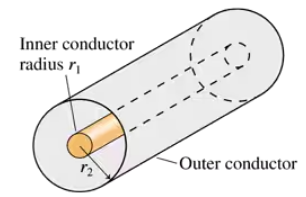
CALC High-frequency signals are often transmitted along a coaxial cable, such as the one shown in FIGURE CP30.86. For example, the cable TV hookup coming into your home is a coaxial cable. The signal is carried on a wire of radius r1 while the outer conductor of radius r2 is grounded. A soft, flexible insulating material fills the space between them, and an insulating plastic coating goes around the outside. Evaluate the inductance per meter of a cable having r1 = 0.50 mm and r2 = 3.0 mm.

Verified step by step guidance1
Step 1: Understand the problem. The inductance per unit length of a coaxial cable can be calculated using the formula for inductance of a coaxial cable: \( L = \frac{\mu_0}{2\pi} \ln\left(\frac{r_2}{r_1}\right) \), where \( \mu_0 \) is the permeability of free space (\( \mu_0 = 4\pi \times 10^{-7} \ \text{H/m} \)), \( r_1 \) is the radius of the inner conductor, and \( r_2 \) is the radius of the outer conductor.
Step 2: Substitute the given values for \( r_1 \) and \( r_2 \) into the formula. The problem states \( r_1 = 0.50 \ \text{mm} = 0.50 \times 10^{-3} \ \text{m} \) and \( r_2 = 3.0 \ \text{mm} = 3.0 \times 10^{-3} \ \text{m} \).
Step 3: Calculate the natural logarithm term \( \ln\left(\frac{r_2}{r_1}\right) \). This involves dividing \( r_2 \) by \( r_1 \) and then taking the natural logarithm of the result.
Step 4: Multiply the result of the logarithm by \( \frac{\mu_0}{2\pi} \). Here, \( \mu_0 \) is \( 4\pi \times 10^{-7} \ \text{H/m} \), and \( 2\pi \) is a constant.
Step 5: The final result will give the inductance per meter of the coaxial cable. Ensure the units are consistent throughout the calculation, and the result will be in henries per meter (H/m).

Verified video answer for a similar problem:
This video solution was recommended by our tutors as helpful for the problem above.
Video duration:
12mWas this helpful?
Key Concepts
Here are the essential concepts you must grasp in order to answer the question correctly.
Coaxial Cable Structure
A coaxial cable consists of an inner conductor and an outer conductor, separated by an insulating material. The inner conductor carries the signal, while the outer conductor serves as a ground and helps shield the signal from external interference. The radii of these conductors, denoted as r1 for the inner and r2 for the outer, are crucial for calculating various electrical properties, including inductance.
Recommended video:
Guided course
Multiple Cables on a Loudspeaker
Inductance
Inductance is a property of an electrical conductor that quantifies its ability to store energy in a magnetic field when an electric current flows through it. For coaxial cables, the inductance per unit length can be calculated using the radii of the inner and outer conductors. This property is essential for understanding how signals propagate through the cable and how they may be affected by frequency.
Recommended video:
Guided course
Mutual Induction
Electromagnetic Theory
Electromagnetic theory describes how electric and magnetic fields interact and propagate through space. In the context of coaxial cables, it explains how the alternating current in the inner conductor generates a magnetic field, which influences the inductance. Understanding these principles is vital for analyzing signal transmission and the behavior of high-frequency signals in coaxial cables.
Recommended video:
Guided course
Introduction to Kinetic-Molecular Theory
Related Practice
Textbook Question
77
views
Textbook Question
CALC The rectangular loop in FIGURE CP30.81 has 0.020 Ω resistance. What is the induced current in the loop at this instant?
157
views
Textbook Question
CALC Let's look at the details of eddy-current braking. A square loop, length l on each side, is shot with velocity v0 into a uniform magnetic field B. The field is perpendicular to the plane of the loop. The loop has mass m and resistance R, and it enters the field at t=0 s. Assume that the loop is moving to the right along the x-axis and that the field begins at x = 0 m. Calculate and draw a graph of v over the interval 0 s ≤ t ≤ 0.04 s for the case that v0=10 m/s, l = 10 cm, m = 1.0 g, R = 0.0010 Ω, and B=0.10 T. The back edge of the loop does not reach the field during this time interval.
45
views
