
It is proposed that future space stations create an artificial gravity by rotating. Suppose a space station is constructed as a 1000-m-diameter cylinder that rotates about its axis. The inside surface is the deck of the space station. What rotation period will provide 'normal' gravity?
Verified step by step guidance
Verified video answer for a similar problem:
Key Concepts
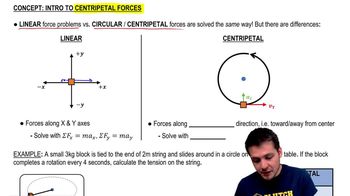
Centripetal Acceleration
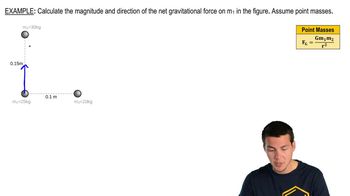
Gravitational Force
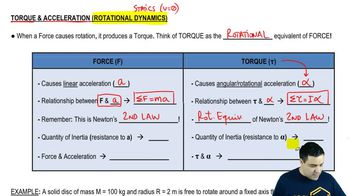
Rotational Dynamics
A 200 g block on a 50-cm-long string swings in a circle on a horizontal, frictionless table at 75 rpm. What is the tension in the string?
Communications satellites are placed in circular orbits where they stay directly over a fixed point on the equator as the Earth rotates. These are called geosynchronous orbits. The altitude of a geosynchronous orbit is 3.58 x 10⁷ m (approximately 22,00 miles). Astronomical data are inside the back cover of the book. Find the value of g at this altitude.
Suppose the moon were held in its orbit not by gravity but by a massless cable attached to the center of the earth. What would be the tension in the cable? Use the table of astronomical data inside the back cover of the book.
A satellite orbiting the moon very near the surface has a period of 110 min. What is free-fall acceleration on the surface of the moon? Astronomical data are inside the back cover of the book.
A 5.0 g coin is placed 15 cm from the center of a turntable. The coin has static and kinetic coefficients of friction with the turntable surface of μs = 0.80 and μk = 0.50. The turntable very slowly speeds up to 60 rpm. Does the coin slide off?
