Ch. 23 - Electric Potential
Giancoli Douglas - Physics for Scientists and Engineers 5th edition
Giancoli Douglas5th editionPhysics for Scientists and EngineersISBN: 9780137488179Not the one you use?Change textbook
Chapter 22, Problem 12

What minimum radius must a large conducting sphere (of an electrostatic generating machine) have if it is to be at 45,000 V without discharge into the air? How much charge will it carry?

Verified step by step guidance
1
Understand the problem: The sphere must not discharge into the air at 45,000 V. The electric field at the surface of the sphere must not exceed the breakdown electric field of air, which is approximately 3 × 10^6 V/m. Use this to determine the minimum radius of the sphere.
Relate the electric field at the surface of a conducting sphere to its potential and radius using the formula: E = VR, where E is the electric field, V is the potential, and R is the radius of the sphere.
Set the electric field equal to the breakdown field of air: VR = 3 × 10^6. Solve for R by rearranging the equation: R = VE.
Substitute the given potential V = 45,000 V and the breakdown field E = 3 × 10^6 V/m into the formula to calculate the minimum radius R.
To find the charge the sphere carries, use the formula for the potential of a conducting sphere: V = Q(4πε)R, where Q is the charge, ε is the permittivity of free space (ε = 8.85 × 10^-12 F/m), and R is the radius. Rearrange to solve for Q: Q = V × (4πε)R.

Verified video answer for a similar problem:

This video solution was recommended by our tutors as helpful for the problem above.
Video duration:
7m
Was this helpful?

Key Concepts

Here are the essential concepts you must grasp in order to answer the question correctly.

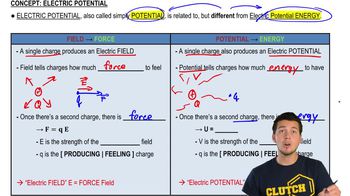
Electric Potential and Voltage

Electric potential, or voltage, is the amount of electric potential energy per unit charge at a point in an electric field. In this context, a voltage of 45,000 V indicates the potential energy available to move a charge within the electric field created by the conducting sphere. Understanding how voltage relates to electric fields is crucial for determining the sphere's radius to prevent discharge.
Recommended video:
Guided course
07:33
Electric Potential

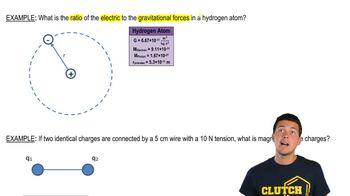
Coulomb's Law

Coulomb's Law describes the force between two charged objects, stating that the force is directly proportional to the product of the magnitudes of the charges and inversely proportional to the square of the distance between them. This principle is essential for calculating the charge on the sphere and understanding how the electric field behaves around it, particularly in relation to the radius required to maintain a specific voltage without discharge.
Recommended video:
Guided course
09:52
Coulomb's Law

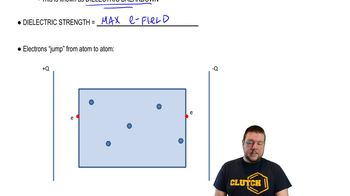
Breakdown Voltage and Discharge

Breakdown voltage is the minimum voltage that causes a portion of an insulator to become conductive, leading to discharge. For air, this value is approximately 3 million volts per meter. In this scenario, knowing the breakdown voltage helps determine the maximum electric field strength the sphere can generate without causing a discharge, which directly influences the minimum radius needed to maintain the specified voltage safely.
Recommended video:
Guided course
04:32
Dielectric Breakdown