Ch. 17 - Temperature, Thermal Expansion, and the Ideal Gas Law
Giancoli Douglas - Physics for Scientists and Engineers 5th edition
Giancoli Douglas5th editionPhysics for Scientists and EngineersISBN: 9780137488179Not the one you use?Change textbook
Chapter 17, Problem 14

At a given latitude, ocean water in the so-called mixed layer (from the surface to a depth of about 50 m) is at approximately the same temperature due to the mixing action of waves. Assume that because of global warming, the temperature of the mixed layer is everywhere increased by 0.5°C, while the temperature of the deeper portions of the ocean remains unchanged. Estimate the resulting rise in sea level. The ocean covers about 70% of the Earth’s surface.

Verified step by step guidance
1
Understand the problem: The rise in sea level is caused by the thermal expansion of water in the mixed layer of the ocean due to an increase in temperature. We need to calculate the volume expansion of the mixed layer and relate it to the rise in sea level.
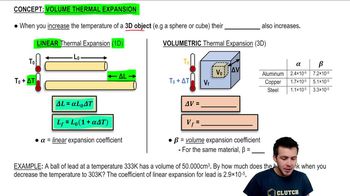
Step 1: Use the formula for volume expansion due to temperature change: ΔV = β * V₀ * ΔT, where β is the coefficient of volume expansion for water, V₀ is the initial volume of the mixed layer, and ΔT is the temperature change (0.5°C).
Step 2: Calculate the initial volume of the mixed layer, V₀. The volume is given by V₀ = A * h, where A is the surface area of the ocean (70% of Earth's surface area) and h is the depth of the mixed layer (50 m). Earth's surface area can be approximated as 4πR², where R is Earth's radius (~6,371 km).
Step 3: Substitute the values into the volume expansion formula to find ΔV. This gives ΔV = β * (A * h) * ΔT. The coefficient of volume expansion for water, β, is approximately 2.1 × 10⁻⁴ °C⁻¹.
Step 4: Relate the volume expansion ΔV to the rise in sea level, Δh. Since the volume expansion is spread over the same surface area, Δh = ΔV / A. Substitute the expression for ΔV from Step 3 into this formula to find Δh in terms of known quantities.

Verified video answer for a similar problem:

This video solution was recommended by our tutors as helpful for the problem above.
Video duration:
4m
Was this helpful?

Key Concepts

Here are the essential concepts you must grasp in order to answer the question correctly.

Thermal Expansion

Thermal expansion refers to the increase in volume of a substance as its temperature rises. In the context of ocean water, as the temperature of the mixed layer increases, the water expands, leading to a rise in sea level. This phenomenon is crucial for understanding how temperature changes can affect oceanic volumes and consequently sea levels.
Recommended video:
Guided course
05:21
Volume Thermal Expansion

Mixed Layer of the Ocean

The mixed layer is the upper layer of the ocean, typically extending from the surface to about 50 meters deep, where water is well-mixed due to wind and wave action. This layer has a relatively uniform temperature and salinity, making it significant for understanding heat distribution in the ocean and its impact on sea level changes.
Recommended video:
Guided course
04:27
Mixing Hot & Cold Water

Sea Level Rise Estimation

Estimating sea level rise involves calculating the volume of water displaced by thermal expansion and other factors. In this scenario, the increase in temperature of the mixed layer leads to a specific volume increase, which can be translated into a rise in sea level across the vast area of the ocean, accounting for the Earth's surface coverage.
Recommended video:
Guided course
04:25
Sound Intensity Level and the Decibel Scale