Ch 19: Work, Heat, and the First Law of Thermodynamics
Knight Calc - Physics for Scientists and Engineers 5th Edition
Knight Calc5th EditionPhysics for Scientists and EngineersISBN: 9780137344796Not the one you use?Change textbook
Chapter 19, Problem 35

You are boiling pasta and absentmindedly grab a copper stirring spoon rather than your wooden spoon. The copper spoon has a 20 mm ×1.5 mm rectangular cross section, and the distance from the boiling water to your 35°C hand is 18 cm. How long does it take the spoon to transfer 25 J of energy to your hand?

Verified step by step guidance
1
Step 1: Identify the formula for heat conduction. The rate of heat transfer through a material is given by Fourier's law: \( Q = \frac{k \cdot A \cdot \Delta T \cdot t}{L} \), where \( Q \) is the heat transferred, \( k \) is the thermal conductivity of the material, \( A \) is the cross-sectional area, \( \Delta T \) is the temperature difference, \( t \) is the time, and \( L \) is the length of the material.
Step 2: Calculate the cross-sectional area \( A \) of the copper spoon. The cross-section is rectangular, so \( A = \text{width} \times \text{height} = 20 \, \text{mm} \times 1.5 \, \text{mm} = 20 \times 10^{-3} \cdot 1.5 \times 10^{-3} \, \text{m}^2 \).
Step 3: Determine the temperature difference \( \Delta T \). The boiling water is at \( 100^{\circ} \text{C} \) and your hand is at \( 35^{\circ} \text{C} \), so \( \Delta T = 100 - 35 = 65^{\circ} \text{C} \).
Step 4: Rearrange Fourier's law to solve for time \( t \): \( t = \frac{Q \cdot L}{k \cdot A \cdot \Delta T} \). Substitute the given values: \( Q = 25 \, \text{J} \), \( L = 18 \, \text{cm} = 0.18 \, \text{m} \), \( k \) (thermal conductivity of copper) \( \approx 385 \, \text{W/m·K} \), \( A \) (calculated in Step 2), and \( \Delta T \) (calculated in Step 3).
Step 5: Perform the substitution and simplify the expression to find \( t \). Ensure all units are consistent (meters, seconds, joules, etc.) before calculating the time required for the spoon to transfer 25 J of energy to your hand.

Verified video answer for a similar problem:

This video solution was recommended by our tutors as helpful for the problem above.
Video duration:
5m
Was this helpful?

Key Concepts

Here are the essential concepts you must grasp in order to answer the question correctly.

Heat Transfer

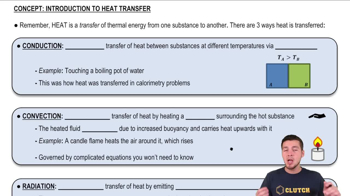
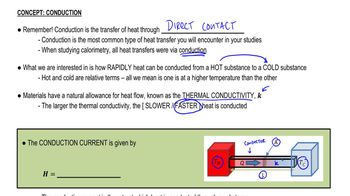
Heat transfer is the process by which thermal energy moves from a hotter object to a cooler one. This can occur through conduction, convection, or radiation. In the context of the question, the copper spoon conducts heat from the boiling water to your hand, illustrating conduction, which is the transfer of heat through direct contact between materials.
Recommended video:
Guided course
05:14
Overview of Heat Transfer

Thermal Conductivity

Thermal conductivity is a material property that indicates how well a substance can conduct heat. Copper has a high thermal conductivity, meaning it transfers heat efficiently compared to materials like wood. This property is crucial in determining how quickly the spoon will transfer energy to your hand when it comes into contact with the boiling water.
Recommended video:

Energy Transfer and Time

The rate of energy transfer is related to both the thermal conductivity of the material and the temperature difference between the two objects. In this scenario, the time it takes for the spoon to transfer 25 J of energy to your hand can be calculated using the formula Q = k * A * (ΔT / d) * t, where Q is the heat transferred, k is the thermal conductivity, A is the cross-sectional area, ΔT is the temperature difference, and d is the distance.
Recommended video:
Guided course
05:14
Overview of Heat Transfer
Related Practice
Textbook Question

The volume of a gas is halved during an adiabatic compression that increases the pressure by a factor of 2.5. By what factor does the temperature increase?

337
views

Textbook Question

A 5.0 g ice cube at −20°C is in a rigid, sealed container from which all the air has been evacuated. How much heat is required to change this ice cube into steam at 200°C? Steam has cV = 1500 J/kg K and cP = 1960 J/kg K.

1233
views
Textbook Question

The burner on an electric stove has a power output of 2.0 kW. A 750 g stainless steel teakettle is filled with 20°C water and placed on the already hot burner. If it takes 3.0 min for the water to reach a boil, what volume of water, in cm3, was in the kettle? Stainless steel is mostly iron, so you can assume its specific heat is that of iron.

1396
views
Textbook Question

A gas cylinder holds 0.10 mol of O₂ at 150°C and a pressure of 3.0 atm. The gas expands adiabatically until the volume is doubled. What are the final pressure?

1002
views
Textbook Question

A 5.0-m-diameter garden pond is 30 cm deep. Solar energy is incident on the pond at an average rate of 400 W/m2. If the water absorbs all the solar energy and does not exchange energy with its surroundings, how many hours will it take to warm from 15°C to 25°C?

1870
views
Textbook Question

The ends of a 20-cm-long, 2.0-cm-diameter rod are maintained at 0°C and 100°C by immersion in an ice-water bath and boiling water. Heat is conducted through the rod at 4.5×10⁴ J per hour. Of what material is the rod made?

1380
views