
A man pushes on a piano with mass kg; it slides at constant velocity down a ramp that is inclined at above the horizontal floor. Neglect any friction acting on the piano. Calculate the magnitude of the force applied by the man if he pushes parallel to the incline.
An astronaut is inside a kg rocket that is blasting off vertically from the launch pad. You want this rocket to reach the speed of sound ( m/s) as quickly as possible, but astronauts are in danger of blacking out at an acceleration greater than . What is the maximum initial thrust this rocket's engines can have but just barely avoid blackout? Start with a free-body diagram of the rocket.
Verified step by step guidance
Verified video answer for a similar problem:
Key Concepts
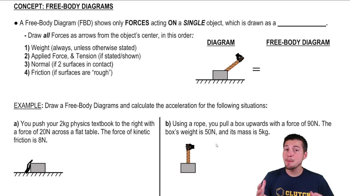
Free-Body Diagram
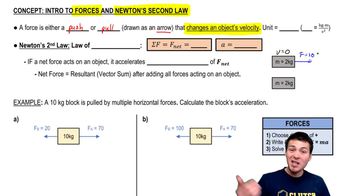
Newton's Second Law of Motion
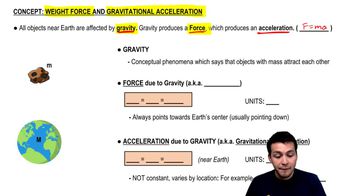
Acceleration and G-Forces
A man pushes on a piano with mass kg; it slides at constant velocity down a ramp that is inclined at above the horizontal floor. Neglect any friction acting on the piano. Calculate the magnitude of the force applied by the man if he pushes parallel to the floor.
On September 8, 2004, the Genesis spacecraft crashed in the Utah desert because its parachute did not open. The -kg capsule hit the ground at km/h and penetrated the soil to a depth of cm. What was its acceleration (in m/s2 and in g's), assumed to be constant, during the crash?
On September 8, 2004, the Genesis spacecraft crashed in the Utah desert because its parachute did not open. The -kg capsule hit the ground at km/h and penetrated the soil to a depth of cm. What force did the ground exert on the capsule during the crash? Express the force in newtons and as a multiple of the capsule's weight.
A -kg car is held in place by a light cable on a very smooth (frictionless) ramp (Fig. E). The cable makes an angle of above the surface of the ramp, and the ramp itself rises at above the horizontal. How hard does the surface of the ramp push on the car?
An astronaut is inside a kg rocket that is blasting off vertically from the launch pad. You want this rocket to reach the speed of sound ( m/s) as quickly as possible, but astronauts are in danger of blacking out at an acceleration greater than . What force, in terms of the astronaut's weight , does the rocket exert on her? Start with a free-body diagram of the astronaut.
