
A rubber ball is shot straight up from the ground with speed v₀. Simultaneously, a second rubber ball at height h directly above the first ball is dropped from rest. At what height above the ground do the balls collide? Your answer will be an algebraic expression in terms of h, v₀, and g.
A rubber ball is shot straight up from the ground with speed v0. Simultaneously, a second rubber ball at height h directly above the first ball is dropped from rest. What is the maximum value of h for which a collision occurs before the first ball falls back to the ground?
Verified step by step guidance
Verified video answer for a similar problem:
Key Concepts
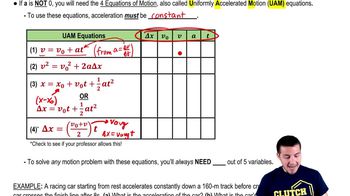
Kinematics
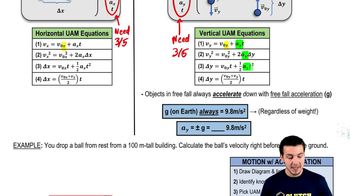
Free Fall
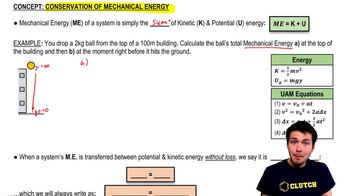
Conservation of Energy
A sprinter can accelerate with constant acceleration for 4.0 s before reaching top speed. He can run the 100 meter dash in 10.0 s. What is his speed as he crosses the finish line?
Careful measurements have been made of Olympic sprinters in the 100 meter dash. A quite realistic model is that the sprinter's velocity is given by v𝓍 = a ( 1 - e⁻ᵇᵗ ) where t is in s, v𝓍 is in m/s, and the constants a and b are characteristic of the sprinter. Sprinter Carl Lewis's run at the 1987 World Championships is modeled with a = 11.81 m/s and b = 0.6887 s⁻¹. Find an expression for the distance traveled at time t.
A rubber ball is shot straight up from the ground with speed v₀. Simultaneously, a second rubber ball at height h directly above the first ball is dropped from rest. For what value of h does the collision occur at the instant when the first ball is at its highest point?
