
Ch 22: Gauss' Law
Young & Freedman Calc - University Physics 14th Edition
Young & Freedman Calc14th EditionUniversity PhysicsISBN: 9780321973610Not the one you use?Change textbook
Chapter 22, Problem 40b

A very long conducting tube (hollow cylinder) has inner radius AA and outer radius bb. It carries charge per unit length +α, where αα is a positive constant with units of C/m. A line of charge lies along the axis of the tube. The line of charge has charge per unit length. What is the charge per unit length on (i) the inner surface of the tube and (ii) the outer surface of the tube?

Verified step by step guidance
1
Understand the problem: We have a conducting tube with inner radius A and outer radius B, carrying a charge per unit length +α. A line of charge with the same charge per unit length +α is along the axis of the tube. We need to find the charge per unit length on the inner and outer surfaces of the tube.
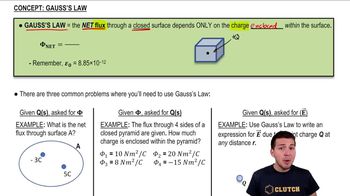
Apply Gauss's Law: For a cylindrical Gaussian surface inside the conductor but outside the line of charge, the electric field inside a conductor in electrostatic equilibrium is zero. Therefore, the net charge enclosed by this Gaussian surface must be zero.
Determine the charge on the inner surface: Since the line of charge has a charge per unit length +α, the inner surface of the tube must have a charge per unit length of -α to ensure the electric field inside the conductor is zero.
Calculate the total charge on the tube: The tube itself has a charge per unit length of +α. Since the inner surface has a charge per unit length of -α, the outer surface must have a charge per unit length that accounts for the total charge of the tube.
Find the charge on the outer surface: The charge per unit length on the outer surface of the tube is the sum of the tube's charge per unit length and the negative of the inner surface charge per unit length, which results in +2α.

Verified video answer for a similar problem:

This video solution was recommended by our tutors as helpful for the problem above.
Video duration:
6m
Was this helpful?

Key Concepts

Here are the essential concepts you must grasp in order to answer the question correctly.

Gauss's Law

Gauss's Law relates the electric flux through a closed surface to the charge enclosed by that surface. It is essential for calculating electric fields in symmetric charge distributions, such as cylindrical geometries. For a long conducting tube, Gauss's Law helps determine how charge distributes on the inner and outer surfaces based on the symmetry and enclosed charge.
Recommended video:

Conductors in Electrostatic Equilibrium

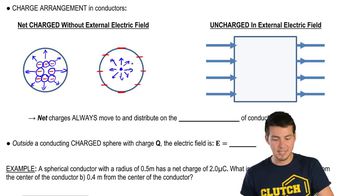
In electrostatic equilibrium, conductors have no electric field inside them, and any excess charge resides on their surface. This principle is crucial for understanding how charges distribute on the inner and outer surfaces of a conducting tube. The inner surface will adjust to neutralize the field from the line charge, while the outer surface will carry any remaining charge.
Recommended video:
Guided course
07:43
Electric Fields in Conductors

Charge Distribution on Cylindrical Surfaces

Charge distribution on cylindrical surfaces depends on the geometry and symmetry of the system. For a hollow conducting cylinder, the charge per unit length on the inner surface will counteract the line charge along the axis, while the outer surface will carry the net charge per unit length. Understanding this distribution is key to solving the problem of charge per unit length on each surface.
Recommended video:
Guided course
09:18
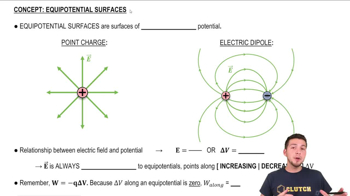
Equipotential Surfaces