
Textbook Question
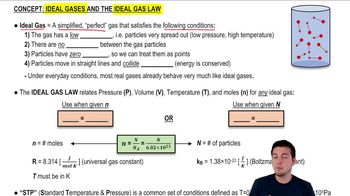
A gas at 100°C fills volume V₀. If the pressure is held constant, what is the volume if the Kelvin temperature is doubled?
1561
views

 Verified step by step guidance
 04:33
04:33
 07:21
07:21 8:39
8:39A gas at 100°C fills volume V₀. If the pressure is held constant, what is the volume if the Kelvin temperature is doubled?
A gas at 100°C fills volume V0. If the pressure is held constant, what is the volume if the Celsius temperature is doubled?
The total lung capacity of a typical adult is 5.0 L. Approximately 20% of the air is oxygen. At sea level and at a body temperature of 37°C, how many oxygen molecules do the lungs contain at the end of a strong inhalation?
A surveyor has a steel measuring tape that is calibrated to be 100.000 m long (i.e., accurate to ±1 mm) at 20°C. If she measures the distance between two stakes to be 65.175 m on a 3°C day, does she need to add or subtract a correction factor to get the true distance? How large, in mm, is the correction factor?
At room temperature (20°C), a 5.0-cm-long brass rod is 20 μm too long to fit into a slot. To what temperature should you cool the rod so that it just barely fits?