
Ch. 06 - Gravitation and Newton's Synthesis
Giancoli Douglas - Physics for Scientists and Engineers 5th edition
Giancoli Douglas5th editionPhysics for Scientists and EngineersISBN: 9780137488179Not the one you use?Change textbook
Chapter 6, Problem 44d

An inclined plane, fixed to the inside of an elevator, makes a 38° angle with the floor. A mass m slides on the plane without friction. What is its acceleration relative to the plane if the elevator moves upward at constant speed?

Verified step by step guidance
1
Identify the forces acting on the mass: The forces include the gravitational force (mg) acting vertically downward and the normal force exerted by the inclined plane perpendicular to its surface. Since there is no friction, we do not consider any frictional force.
Analyze the motion of the elevator: The problem states that the elevator moves upward at a constant speed. This means there is no net acceleration of the elevator, and the only acceleration to consider is due to the forces acting on the mass relative to the inclined plane.
Resolve the gravitational force into components: The gravitational force can be broken into two components relative to the inclined plane: one parallel to the plane, \( F_{\text{parallel}} = mg \sin(\theta) \), and one perpendicular to the plane, \( F_{\text{perpendicular}} = mg \cos(\theta) \), where \( \theta = 38^\circ \).
Determine the net force causing acceleration: Since the elevator is moving at constant speed, the only force causing acceleration relative to the plane is the parallel component of gravity, \( F_{\text{parallel}} = mg \sin(\theta) \).
Calculate the acceleration relative to the plane: Use Newton's second law, \( F = ma \), to find the acceleration. The net force is \( F_{\text{parallel}} = mg \sin(\theta) \), so the acceleration relative to the plane is \( a = g \sin(\theta) \), where \( g \) is the acceleration due to gravity.

Verified video answer for a similar problem:

This video solution was recommended by our tutors as helpful for the problem above.
Was this helpful?

Key Concepts

Here are the essential concepts you must grasp in order to answer the question correctly.

Inclined Plane Dynamics

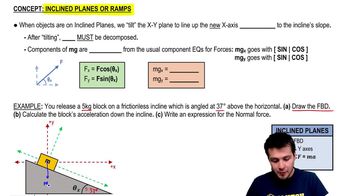
An inclined plane is a flat surface tilted at an angle to the horizontal. When an object slides down an inclined plane, its acceleration is influenced by the angle of inclination and the gravitational force acting on it. The component of gravitational force acting parallel to the plane determines the object's acceleration along the surface.
Recommended video:
Guided course
06:59
Intro to Inclined Planes

Relative Motion

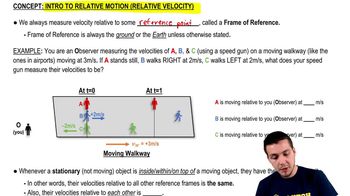
Relative motion refers to the calculation of the motion of an object as observed from a particular reference frame. In this scenario, the acceleration of the mass m must be analyzed from the perspective of the inclined plane, which is fixed within an elevator. Understanding how the elevator's motion affects the perceived acceleration is crucial for solving the problem.
Recommended video:
Guided course
04:27
Intro to Relative Motion (Relative Velocity)

Constant Velocity in an Elevator

When an elevator moves upward at constant speed, it does not exert any additional acceleration on the objects inside it. This means that the only forces acting on the mass m are gravitational force and the normal force from the inclined plane. The absence of acceleration from the elevator simplifies the analysis, as the effective gravitational force remains unchanged.
Recommended video:
Guided course
08:59
Phase Constant of a Wave Function
Related Practice
Textbook Question

A particle is released at a height rE (radius of Earth) above the Earth’s surface. Determine its velocity when it hits the Earth. Ignore air resistance. [Hint: Use Newton’s second law, the law of universal gravitation, the chain rule, and integrate.]

1407
views
Textbook Question

The value of g is altered by approximately Δg2gΔrrE\(\Delta\) g\(\thickapprox\)-2g\(\frac{\Delta r}{r_{E}\)} at a height ∆r above the Earth’s surface, where rE is the radius of the Earth, as long as ∆r ≪ rE. What is the meaning of the minus sign in this relation?

1279
views
Textbook Question

Determine the mean distance from Jupiter for each of Jupiter’s principal moons, using Kepler’s third law. Use the mean distance of Io and the periods given in Table 6–3. Compare your results to the values in Table 6–3.

1107
views
Textbook Question

A satellite circles a spherical planet of unknown mass in a circular orbit of radius 1.6 x 10⁷ m. The magnitude of the gravitational force exerted on the satellite by the planet is 120 N. What would be the magnitude of the gravitational force exerted on the satellite by the planet if the radius of the orbit were increased to 3.0 x 10⁷m?

166
views
Textbook Question

An inclined plane, fixed to the inside of an elevator, makes a 38° angle with the floor. A mass m slides on the plane without friction. What is its acceleration relative to the plane if the elevator accelerates downward at 0.50 g?

91
views
Textbook Question

An inclined plane, fixed to the inside of an elevator, makes a 38° angle with the floor. A mass m slides on the plane without friction. What is its acceleration relative to the plane if the elevator falls freely?

1387
views