
Ch. 21 - Electric Charge and Electric Field
Giancoli Douglas - Physics for Scientists and Engineers 5th edition
Giancoli Douglas5th editionPhysics for Scientists and EngineersISBN: 9780137488179Not the one you use?Change textbook
Chapter 21, Problem 69

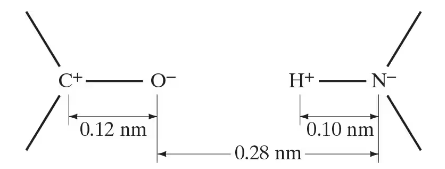
Estimate the net force between the CO group and the HN group shown in Fig. 21–72. The C and O have charges ± 0.40e, and the H and N have charges ±0.20e, where e = 1.6 x 10⁻¹⁹ C. [Hint: Do not include the “internal” forces between C and O, or between H and N.]
Diagram showing charged atoms: C+ and O- at 0.12 nm, H+ and N- at 0.10 nm, with a distance of 0.28 nm between groups.

Verified step by step guidance
1
Identify the charges involved: The charges on the C and O atoms are ±0.40e, and the charges on the H and N atoms are ±0.20e. Here, e = 1.6 × 10⁻¹⁹ C.
Understand the hint: The problem specifies not to include the internal forces between C and O or between H and N. This means we only consider the forces between the C-H and O-N pairs.
Use Coulomb's law to calculate the force between two charges: The formula is F = (1 / (4πϵ₀)) * (|q₁ * q₂| / r²), where q₁ and q₂ are the charges, r is the distance between them, and ϵ₀ is the permittivity of free space (ϵ₀ = 8.85 × 10⁻¹² C²/N·m²).
Calculate the net force: Since there are two pairs of interactions (C-H and O-N), calculate the force for each pair using Coulomb's law. Then, determine the vector sum of these forces to find the net force. Consider the geometry of the system (angles and distances) to resolve the forces into components if necessary.
Combine the results: Add the force components from the C-H and O-N interactions to find the magnitude and direction of the net force. Ensure proper vector addition and account for the relative positions of the charges.

Verified video answer for a similar problem:

This video solution was recommended by our tutors as helpful for the problem above.
Video duration:
13m
Was this helpful?

Key Concepts

Here are the essential concepts you must grasp in order to answer the question correctly.

Coulomb's Law

Coulomb's Law describes the electrostatic force between two charged particles. It states that the force is directly proportional to the product of the magnitudes of the charges and inversely proportional to the square of the distance between them. This law is fundamental in calculating the net force between charged groups, such as the CO and HN groups in the question.
Recommended video:
Guided course
09:52
Coulomb's Law

Charge Quantization

Charge quantization refers to the principle that electric charge exists in discrete amounts, specifically as integer multiples of the elementary charge (e). In this case, the charges of the atoms are given as ±0.40e and ±0.20e, which are essential for calculating the forces between the groups. Understanding this concept is crucial for accurately determining the net force based on the specified charges.
Recommended video:
Guided course
05:37
Electric Charge

Vector Addition of Forces

When multiple forces act on an object, the net force is found by vector addition, which considers both the magnitude and direction of each force. In this scenario, while calculating the net force between the CO and HN groups, it is important to recognize that forces can be attractive or repulsive, and their directions will affect the overall net force. This concept is vital for correctly interpreting the interactions between the charged groups.
Recommended video:
Guided course
07:30
Vector Addition By Components