Ch. 21 - Electric Charge and Electric Field
Giancoli Douglas - Physics for Scientists and Engineers 5th edition
Giancoli Douglas5th editionPhysics for Scientists and EngineersISBN: 9780137488179Not the one you use?Change textbook
Chapter 21, Problem 76

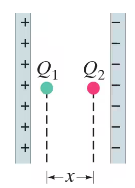
Two point charges, Q₁ = ― 6.7 μC and Q₂ = 2.6 μC, are located between two oppositely charged parallel plates, as shown in Fig. 21–74. The two charges are separated by a distance of 𝓍 = 0.47 m. Assume that the electric field produced by the charged plates is uniform and equal to E = 53,000 N/C . Calculate the net electrostatic force on Q₁ and give its direction.
Two point charges, Q₁ and Q₂, are positioned between oppositely charged plates, with a distance of 0.47 m between them.

Verified step by step guidance
1
Identify the forces acting on Q₁: The net electrostatic force on Q₁ is the result of two forces: (1) the force due to the electric field created by the parallel plates, and (2) the force due to the interaction between Q₁ and Q₂ (Coulomb's law).
Calculate the force due to the electric field: Use the formula F=qE, where q is the charge of Q₁ and E is the electric field strength. Substitute the given values for Q₁ and E to find the magnitude of this force.
Calculate the force due to Coulomb's law: Use the formula F=kqqr2, where k is Coulomb's constant, q and q are the charges, and r is the separation distance. Substitute the given values to find the magnitude of this force.
Determine the direction of each force: The force due to the electric field will act in the direction of the field (positive or negative depending on the sign of Q₁). The force due to Coulomb's law will depend on whether the charges attract or repel each other (opposite charges attract, like charges repel).
Combine the forces to find the net force: Add the two forces vectorially, taking into account their magnitudes and directions. The result will give the net electrostatic force on Q₁ and its direction.

Verified video answer for a similar problem:

This video solution was recommended by our tutors as helpful for the problem above.
Video duration:
6m
Was this helpful?

Key Concepts

Here are the essential concepts you must grasp in order to answer the question correctly.

Coulomb's Law

Coulomb's Law describes the electrostatic force between two point charges. It states that the force (F) is directly proportional to the product of the magnitudes of the charges (Q₁ and Q₂) and inversely proportional to the square of the distance (r) between them. The formula is F = k * |Q₁ * Q₂| / r², where k is Coulomb's constant. This law is fundamental for calculating the forces acting on charged particles.
Recommended video:
Guided course
09:52
Coulomb's Law

Electric Field

An electric field (E) is a region around a charged object where other charges experience a force. It is defined as the force per unit charge and is measured in newtons per coulomb (N/C). In this scenario, the uniform electric field produced by the charged plates exerts a force on the charges Q₁ and Q₂, influencing their motion and interaction. The direction of the electric field is from positive to negative charges.
Recommended video:
Guided course
03:16
Intro to Electric Fields

Net Force

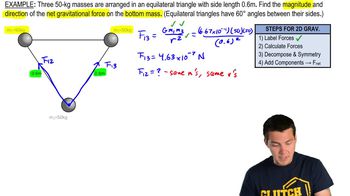
The net force on an object is the vector sum of all individual forces acting on it. In the context of multiple forces, such as the electrostatic force from another charge and the force from an electric field, the net force determines the overall effect on the object's motion. For charge Q₁, the net force will be the combination of the force due to Q₂ and the force due to the electric field, which can be calculated and analyzed to find its direction.
Recommended video:
Guided course
06:28
Finding Net Forces in 2D Gravitation