Ch 25: Current, Resistance, and EMF
Young & Freedman Calc - University Physics 14th Edition
Young & Freedman Calc14th EditionUniversity PhysicsISBN: 9780321973610Not the one you use?Change textbook
Chapter 25, Problem 7a

The current in a wire varies with time according to the relationship I=55A(0.65A/s2)t2I = 55 A - (0.65 A/s^2)t^2 . How many coulombs of charge pass a cross section of the wire in the time interval between t=0t = 0 and t=8.0 st=8.0\(\text{ s}\)?

Verified step by step guidance
1
To find the total charge that passes through the wire, we need to integrate the current function I(t) = 55 A - (0.65 A/s^2)t^2 over the time interval from t = 0 to t = 8.0 s. The charge Q is given by the integral of current with respect to time: Q = ∫ I(t) dt from 0 to 8.0 s.
Set up the integral for the charge: Q = ∫ (55 - 0.65t^2) dt from 0 to 8.0. This involves integrating each term separately.
Integrate the first term: ∫ 55 dt = 55t. Evaluate this from 0 to 8.0 s.
Integrate the second term: ∫ -0.65t^2 dt = -0.65 * (t^3/3). Evaluate this from 0 to 8.0 s.
Add the results of the two integrals to find the total charge Q. For part (b), calculate the constant current I_const by dividing the total charge Q by the time interval (8.0 s), using the formula I_const = Q / 8.0 s.

Verified video answer for a similar problem:

This video solution was recommended by our tutors as helpful for the problem above.
Video duration:
4m
Was this helpful?

Key Concepts

Here are the essential concepts you must grasp in order to answer the question correctly.

Current and Charge Relationship

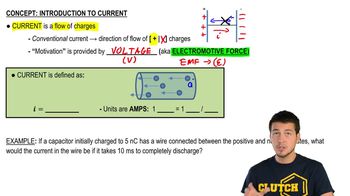
Current (I) is the rate of flow of electric charge (Q) through a conductor. The relationship is given by I = dQ/dt, where I is the current in amperes, Q is the charge in coulombs, and t is time in seconds. To find the total charge passing through a wire over a time interval, you integrate the current with respect to time.
Recommended video:
Guided course
05:38
Intro to Current

Integration of Current Function

To determine the total charge passing through the wire, integrate the given current function I(t) = 55 A - (0.65 A/s^2)t^2 over the specified time interval. This involves calculating the definite integral of I(t) from t = 0 to t = 8.0 s, which provides the total charge in coulombs that has passed through the wire during this period.
Recommended video:
Guided course
11:43
Finding Moment Of Inertia By Integrating

Equivalent Constant Current

An equivalent constant current is a steady current that would transport the same total charge over the same time interval as the varying current. To find this, divide the total charge obtained from the integration by the total time interval. This gives the average current, which represents the constant current needed to transport the same amount of charge in the given time.
Recommended video:
Guided course
08:59
Phase Constant of a Wave Function