Ch 09: Work and Kinetic Energy
Knight Calc - Physics for Scientists and Engineers 5th Edition
Knight Calc5th EditionPhysics for Scientists and EngineersISBN: 9780137344796Not the one you use?Change textbook
Chapter 9, Problem 27b

A 10-cm-long spring is attached to the ceiling. When a 2.0 kg mass is hung from it, the spring stretches to a length of 15 cm. How long is the spring when a 3.0 kg mass is suspended from it?

Verified step by step guidance
1
Step 1: Identify the given quantities. The original length of the spring is 10 cm, and it stretches to 15 cm when a 2.0 kg mass is hung. This means the spring stretches by 5 cm under a force equal to the weight of the 2.0 kg mass. The weight of the mass is given by the formula: F=mg, where m is the mass and g is the acceleration due to gravity (approximately 9.8 m/s²).
Step 2: Calculate the spring constant k using Hooke's Law, which states: F=kx, where F is the force applied, k is the spring constant, and x is the stretch of the spring. Rearrange the formula to solve for k: k=Fx. Substitute the values for F (weight of the 2.0 kg mass) and x (5 cm, converted to meters).
Step 3: Use the calculated spring constant k to determine the stretch of the spring when a 3.0 kg mass is hung. First, calculate the force exerted by the 3.0 kg mass using F=mg. Then, use Hooke's Law x=Fk to find the stretch x caused by the 3.0 kg mass.
Step 4: Add the calculated stretch x to the original length of the spring (10 cm) to find the total length of the spring when the 3.0 kg mass is suspended. Ensure that all units are consistent (convert cm to meters if necessary).
Step 5: Verify the solution by checking the proportionality between the force and the stretch of the spring. Since the spring follows Hooke's Law, the stretch should be directly proportional to the applied force. Confirm that the calculated length is reasonable based on the given data.

Verified video answer for a similar problem:

This video solution was recommended by our tutors as helpful for the problem above.
Video duration:
10m
Was this helpful?

Key Concepts

Here are the essential concepts you must grasp in order to answer the question correctly.

Hooke's Law

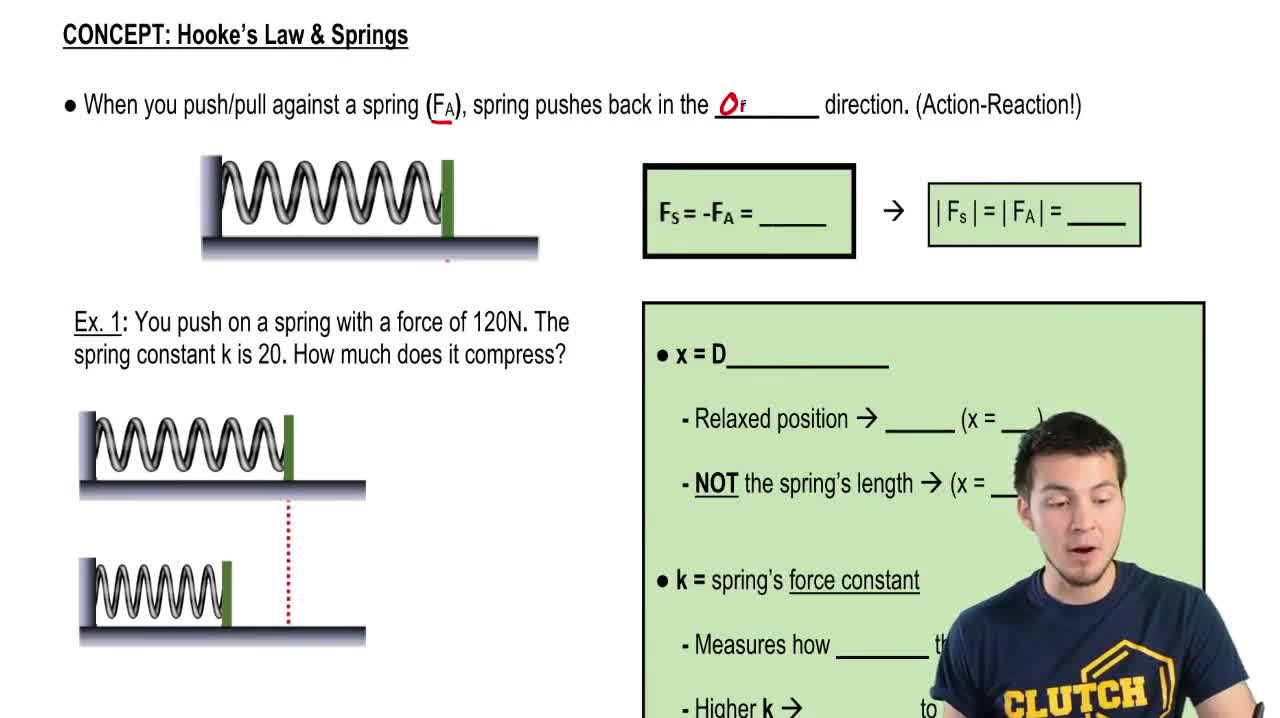
Hooke's Law states that the force exerted by a spring is directly proportional to the amount it is stretched or compressed, as long as the elastic limit is not exceeded. Mathematically, it is expressed as F = kx, where F is the force applied, k is the spring constant, and x is the displacement from the spring's equilibrium position. This principle is essential for understanding how the spring behaves under different weights.
Recommended video:
Guided course
05:27
Spring Force (Hooke's Law)

Spring Constant

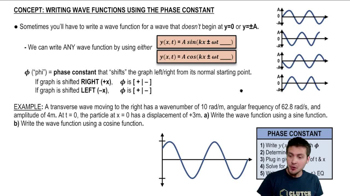
The spring constant (k) is a measure of a spring's stiffness, defined as the ratio of the force exerted on the spring to the displacement it experiences. A higher spring constant indicates a stiffer spring that requires more force to stretch or compress. In this problem, calculating the spring constant using the initial mass and stretch will allow us to predict the behavior of the spring with different weights.
Recommended video:
Guided course
08:59
Phase Constant of a Wave Function

Equilibrium Position

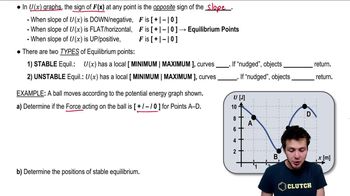
The equilibrium position of a spring is the length at which the spring is neither compressed nor stretched, meaning the net force acting on it is zero. When a mass is hung from the spring, it stretches to a new equilibrium position where the gravitational force on the mass equals the restoring force of the spring. Understanding this concept is crucial for determining how the spring will react to different masses.
Recommended video:
Guided course
05:50
Forces & Equilibrium Positions