
Ch 08: Dynamics II: Motion in a Plane
Knight Calc - Physics for Scientists and Engineers 5th Edition
Knight Calc5th EditionPhysics for Scientists and EngineersISBN: 9780137344796Not the one you use?Change textbook
Chapter 8, Problem 63

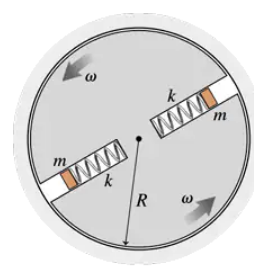
For safety, elevators have a rotational governor, a device that is attached to and rotates with one of the elevator's pulleys. The governor, shown in FIGURE P8.63, is a disk with two hollow channels holding springs with metal blocks of mass m attached to their free ends. The faster the governor spins, the more the springs stretch. At a critical angular velocity ωc, the metal blocks contact the housing, which completes a circuit and activates an emergency brake. The spring force on a mass, which we will explore more thoroughly in Chapter 9, is FSp = k(r - L), where k is the spring constant measured in N/m, and L is the relaxed (unstretched) length of the spring. Suppose a rotational governor has L = 0.80R and the emergency brake activates when the metal blocks reach r = R. What is the critical angular velocity in rpm if R = 15cm, k = 20 N/m, and m = 25g? Ignore gravity.

Verified step by step guidance
1
Step 1: Understand the problem setup. The rotational governor consists of a disk with springs and metal blocks. The spring force is given by FSp = k(r - L), where k is the spring constant, r is the stretched length, and L is the relaxed length. The critical angular velocity ωc occurs when the blocks reach r = R, completing the circuit to activate the emergency brake.
Step 2: Analyze the forces acting on the metal blocks. The blocks experience a centripetal force due to rotation, which is provided by the spring force. The centripetal force is given by Fc = mω²r, where m is the mass of the block, ω is the angular velocity, and r is the radius of rotation.
Step 3: Set up the equation for equilibrium. At the critical angular velocity ωc, the spring force equals the centripetal force: FSp = Fc. Substitute the expressions for FSp and Fc: k(r - L) = mω²r.
Step 4: Solve for ωc. Substitute the given values: r = R, L = 0.80R, k = 20 N/m, m = 25 g (convert to kg: m = 0.025 kg), and R = 15 cm (convert to meters: R = 0.15 m). Rearrange the equation to isolate ω²: ω² = k(r - L) / (mr).
Step 5: Convert ωc to rpm. Once ωc is calculated in radians per second, convert it to revolutions per minute (rpm) using the conversion factor: 1 revolution = 2π radians and 1 minute = 60 seconds. The formula for conversion is rpm = (ωc × 60) / (2π).

Verified video answer for a similar problem:

This video solution was recommended by our tutors as helpful for the problem above.
Was this helpful?

Key Concepts

Here are the essential concepts you must grasp in order to answer the question correctly.

Rotational Dynamics

Rotational dynamics involves the study of the motion of objects that rotate about an axis. Key parameters include angular velocity (ω), which measures how fast an object rotates, and the moment of inertia, which quantifies an object's resistance to changes in its rotational motion. In this context, the governor's rotation is crucial for understanding how the system behaves as it accelerates and reaches critical conditions.
Recommended video:
Guided course
08:12
Torque & Acceleration (Rotational Dynamics)

Spring Force

The spring force is described by Hooke's Law, which states that the force exerted by a spring is proportional to its displacement from the equilibrium position. The formula F<sub>Sp</sub> = k(r - L) indicates that the force increases as the spring stretches beyond its relaxed length (L). In the elevator governor, the spring force plays a vital role in determining when the emergency brake activates based on the centrifugal force acting on the mass.
Recommended video:
Guided course
05:27
Spring Force (Hooke's Law)

Critical Angular Velocity

Critical angular velocity (ω<sub>c</sub>) is the specific rotational speed at which a system transitions from one state to another, such as when the centrifugal force on the mass equals the spring force, causing the blocks to contact the housing. This concept is essential for understanding the conditions under which the emergency brake is triggered in the elevator governor, ensuring safety by preventing excessive speeds.
Recommended video:
Guided course
01:04
Critical Angle
Related Practice
Textbook Question

A 100 g ball on a 60-cm-long string is swung in a vertical circle about a point 200 cm above the floor. The string suddenly breaks when it is parallel to the ground and the ball is moving upward. The ball reaches a height 600 cm above the floor. What was the tension in the string an instant before it broke?

1983
views
Textbook Question

2.0 kg ball swings in a vertical circle on the end of an 80-cm-long string. The tension in the string is 20 N when its angle from the highest point on the circle is θ = 30°. What is the ball's speed when θ = 30°?

2452
views
1
rank
Textbook Question

The 10 mg bead in FIGURE CP8.69 is free to slide on a frictionless wire loop. The loop rotates about a vertical axis with angular velocity ω. If ω is less than some critical value ω꜀, the bead sits at the bottom of the spinning loop. When ω > ω꜀, the bead moves out to some angle θ. What is ω꜀ in rpm for the loop shown in the figure?

2536
views
Textbook Question

In the absence of air resistance, a projectile that lands at the elevation from which it was launched achieves maximum range when launched at a 45° angle. Suppose a projectile of mass m is launched with speed into a headwind that exerts a constant, horizontal retarding force Fwind=Fwindı^.\(\vec{F}\)_{\(\text{wind}\)} = -F_{\(\text{wind}\)} \(\hat{\imath}\). By what percentage is the maximum range of a 0.50 kg ball reduced if Fwind=0.60 NF_{\(\text{wind}\)}=0.60\(\text{ N}\)?

2355
views
Textbook Question

Scientists design a new particle accelerator in which protons (mass 1.7 X 10⁻²⁷ kg) follow a circular trajectory given by r=ccos(kt2)i+csin(kt2)j\(\mathbf{r}\) = c \(\cos\)(kt^2) \(\mathbf{i}\) + c \(\sin\)(kt^2) \(\mathbf{j}\) where c = 5.0 m and k = 8.0 x 10⁴ rad/s2 are constants and t is the elapsed time. What is the radius of the circle?

2244
views
Textbook Question

In the absence of air resistance, a projectile that lands at the elevation from which it was launched achieves maximum range when launched at a 45° angle. Suppose a projectile of mass m is launched with speed into a headwind that exerts a constant, horizontal retarding force Fwind=Fwindı^.\(\vec{F}\)_{\(\text{wind}\)} = -F_{\(\text{wind}\)} \(\hat{\imath}\).. Find an expression for the angle at which the range is maximum.

2638
views