
Ch 04: Newton's Laws of Motion
Young & Freedman Calc - University Physics 14th Edition
Young & Freedman Calc14th EditionUniversity PhysicsISBN: 9780321973610Not the one you use?Change textbook
Chapter 4, Problem 23

Boxes AA and BB are in contact on a horizontal, frictionless surface (Fig. E4.234.23). Box AA has mass 20.020.0 kg and box BB has mass 5.05.0 kg. A horizontal force of 250250 N is exerted on box AA. What is the magnitude of the force that box AA exerts on box BB?
Illustration of boxes A and B with a 250 N force on A, demonstrating Newton's Third Law.

Verified step by step guidance
1
Step 1: Identify the system and forces acting on it. Box A and Box B are in contact on a frictionless surface. A horizontal force of 250 N is applied to Box A. The goal is to find the force that Box A exerts on Box B.
Step 2: Calculate the acceleration of the system. Since the surface is frictionless, the net force acting on the system is the applied force. The total mass of the system is the sum of the masses of Box A and Box B. Use Newton's second law, \( F = ma \), to find the acceleration: \( a = \frac{F}{m_{\text{total}}} \), where \( m_{\text{total}} = m_A + m_B \).
Step 3: Analyze the forces acting on Box B. Box B is only influenced by the force exerted by Box A. This force is responsible for accelerating Box B with the same acceleration as the system. Use Newton's second law for Box B: \( F_{A \text{on} B} = m_B \cdot a \).
Step 4: Substitute the value of acceleration from Step 2 into the equation for \( F_{A \text{on} B} \). This will give the magnitude of the force that Box A exerts on Box B.
Step 5: Verify the solution conceptually. Ensure that the calculated force is consistent with the physical situation, where Box A pushes Box B forward due to the applied force.

Verified video answer for a similar problem:

This video solution was recommended by our tutors as helpful for the problem above.
Video duration:
9m
Was this helpful?

Key Concepts

Here are the essential concepts you must grasp in order to answer the question correctly.

Newton's Second Law of Motion

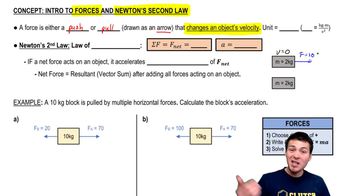
Newton's Second Law states that the acceleration of an object is directly proportional to the net force acting on it and inversely proportional to its mass. This relationship is expressed by the formula F = ma, where F is the net force, m is the mass, and a is the acceleration. In this scenario, the total force applied to box A will determine the acceleration of both boxes A and B since they are in contact.
Recommended video:
Guided course
06:54
Intro to Forces & Newton's Second Law

Newton's Third Law of Motion

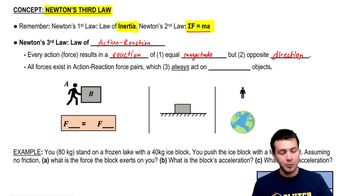
Newton's Third Law states that for every action, there is an equal and opposite reaction. This means that when box A exerts a force on box B, box B exerts an equal and opposite force back on box A. Understanding this concept is crucial for determining the force that box A exerts on box B when a force is applied to box A.
Recommended video:
Guided course
08:01
Newton's Third Law & Action-Reaction Pairs

Frictionless Surface

A frictionless surface is an idealized concept in physics where no frictional forces oppose the motion of objects. This allows for the simplification of calculations, as the only forces acting on the boxes are those applied externally and the normal forces between them. In this problem, the absence of friction means that the entire force applied to box A contributes to the acceleration of both boxes.
Recommended video:
Guided course
09:18
Equipotential Surfaces
Related Practice
Textbook Question

A ball is hanging from a long string that is tied to the ceiling of a train car traveling eastward on horizontal tracks. An observer inside the train car sees the ball hang motionless. Draw a clearly labeled free-body diagram for the ball if the train is speeding up uniformly. Is the net force on the ball zero in either case? Explain.

4006
views
2
rank
Textbook Question

A small car of mass 380380 kg is pushing a large truck of mass 900900 kg due east on a level road. The car exerts a horizontal force of 16001600 N on the truck. What is the magnitude of the force that the truck exerts on the car?

4745
views
Textbook Question

At the surface of Jupiter's moon Io, the acceleration due to gravity is g=1.81g = 1.81 m/s2. A watermelon weighs 44.044.0 N at the surface of the earth. What would be its mass and weight on the surface of Io?

5445
views
Textbook Question

Crates AA and BB sit at rest side by side on a frictionless horizontal surface. They have masses mAm_{A} and mBm_B, respectively. When a horizontal force FF is applied to crate AA, the two crates move off to the right. Draw clearly labeled free-body diagrams for crate AA and for crate BB. Indicate which pairs of forces, if any, are third-law action–reaction pairs.

2822
views
1
rank
Textbook Question

World-class sprinters can accelerate out of the starting blocks with an acceleration that is nearly horizontal and has magnitude 1515 m/s2. How much horizontal force must a 55 55-kg sprinter exert on the starting blocks to produce this acceleration? Which body exerts the force that propels the sprinter: the blocks or the sprinter herself?

4036
views