According to the label on a bottle of salad dressing, the volume of the contents is 0.473 liter (L). Using only the conversions 1 L = 1000 cm3 and 1 in. = 2.54 cm, express this volume in cubic inches.
Verified step by step guidance
1
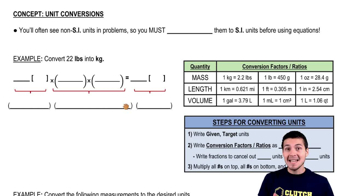
Start by converting the volume from liters to cubic centimeters using the conversion factor: 1 L = 1000 cm³. Multiply the given volume in liters by this factor to find the volume in cubic centimeters.
Next, convert the volume from cubic centimeters to cubic inches. To do this, first convert centimeters to inches using the conversion factor: 1 in = 2.54 cm.
Since the conversion involves cubic measurements, you need to cube the conversion factor for linear dimensions. Therefore, cube the conversion factor: (1 in / 2.54 cm)³.
Multiply the volume in cubic centimeters by the cubed conversion factor to obtain the volume in cubic inches.
Ensure that all units are correctly converted and check your calculations for accuracy. The final expression will give you the volume in cubic inches.
Verified video answer for a similar problem:
This video solution was recommended by our tutors as helpful for the problem above
Video duration:
1m
Play a video:
Was this helpful?
Key Concepts
Here are the essential concepts you must grasp in order to answer the question correctly.
Volume Conversion
Volume conversion involves changing the measurement of volume from one unit to another. In this question, the volume is initially given in liters and needs to be converted to cubic inches. Understanding the conversion factors between liters, cubic centimeters, and cubic inches is essential for accurate calculation.
A unit conversion factor is a ratio used to convert a quantity expressed in one unit to another unit. Here, the conversion factors are 1 L = 1000 cm³ and 1 in = 2.54 cm. These factors allow us to convert the volume from liters to cubic centimeters and then from cubic centimeters to cubic inches.
Dimensional analysis is a method used to convert units by multiplying by conversion factors, ensuring that units cancel appropriately. This technique helps in systematically converting the volume from liters to cubic inches by applying the conversion factors step-by-step, ensuring the final result is in the desired unit.