


Ch. 6 - Confidence Intervals
Larson - Elementary Statistics: Picturing the World 8th Edition
Larson8th EditionElementary Statistics: Picturing the WorldISBN: 9780137493470Not the one you use?Change textbook
Chapter 6, Problem 6.4.6

Finding Critical Values for χ2 In Exercises 3–8, find the critical values χR2 and χL2 for the level of confidence c and sample size n.
c = 0.98, n = 26

Verified step by step guidance
1
Determine the degrees of freedom (df) for the chi-square distribution. The formula for degrees of freedom is df = n - 1, where n is the sample size. In this case, df = 26 - 1.
Identify the level of confidence (c) and calculate the corresponding significance level (α). The significance level is given by α = 1 - c. For c = 0.98, calculate α = 1 - 0.98.
Divide the significance level (α) into two tails for a two-tailed test. The left tail will have an area of α/2, and the right tail will also have an area of α/2.
Use a chi-square distribution table or statistical software to find the critical values. For the left critical value (χL²), find the chi-square value corresponding to an area of 1 - (α/2) to the left of the critical value. For the right critical value (χR²), find the chi-square value corresponding to an area of α/2 to the left of the critical value.
Write down the critical values χL² and χR² obtained from the table or software. These are the values that define the rejection region for the chi-square test at the given level of confidence.

Verified video answer for a similar problem:

This video solution was recommended by our tutors as helpful for the problem above.
Video duration:
2m
Was this helpful?

Key Concepts

Here are the essential concepts you must grasp in order to answer the question correctly.

Chi-Square Distribution

The Chi-Square distribution is a statistical distribution that is used primarily in hypothesis testing and in constructing confidence intervals for variance. It is defined by its degrees of freedom, which are determined by the sample size. In this context, the Chi-Square distribution helps in determining critical values that correspond to a specified level of confidence.
Recommended video:
Guided course
07:01
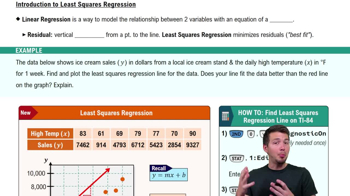
Intro to Least Squares Regression

Critical Values

Critical values are the threshold points that define the boundaries of the acceptance region in hypothesis testing. They are determined based on the desired level of confidence and the distribution being used. For the Chi-Square distribution, critical values are used to assess whether the observed data falls within the expected range under the null hypothesis.
Recommended video:
05:50
Critical Values: t-Distribution

Level of Confidence

The level of confidence, denoted as 'c', represents the probability that the confidence interval will contain the true parameter value. A higher level of confidence indicates a wider interval, while a lower level results in a narrower interval. In this case, a confidence level of 0.98 means that we expect 98% of the intervals constructed from repeated samples to contain the true population parameter.
Recommended video:
06:33
Introduction to Confidence Intervals