One vs. Two What is the fundamental difference between one-way analysis of variance and two-way analysis of variance?
Table of contents
- 1. Intro to Stats and Collecting Data1h 14m
- 2. Describing Data with Tables and Graphs1h 56m
- 3. Describing Data Numerically2h 5m
- 4. Probability2h 17m
- 5. Binomial Distribution & Discrete Random Variables3h 6m
- 6. Normal Distribution and Continuous Random Variables2h 11m
- 7. Sampling Distributions & Confidence Intervals: Mean3h 23m
- Sampling Distribution of the Sample Mean and Central Limit Theorem19m
- Distribution of Sample Mean - ExcelBonus23m
- Introduction to Confidence Intervals15m
- Confidence Intervals for Population Mean1h 18m
- Determining the Minimum Sample Size Required12m
- Finding Probabilities and T Critical Values - ExcelBonus28m
- Confidence Intervals for Population Means - ExcelBonus25m
- 8. Sampling Distributions & Confidence Intervals: Proportion2h 10m
- 9. Hypothesis Testing for One Sample5h 8m
- Steps in Hypothesis Testing1h 6m
- Performing Hypothesis Tests: Means1h 4m
- Hypothesis Testing: Means - ExcelBonus42m
- Performing Hypothesis Tests: Proportions37m
- Hypothesis Testing: Proportions - ExcelBonus27m
- Performing Hypothesis Tests: Variance12m
- Critical Values and Rejection Regions28m
- Link Between Confidence Intervals and Hypothesis Testing12m
- Type I & Type II Errors16m
- 10. Hypothesis Testing for Two Samples5h 37m
- Two Proportions1h 13m
- Two Proportions Hypothesis Test - ExcelBonus28m
- Two Means - Unknown, Unequal Variance1h 3m
- Two Means - Unknown Variances Hypothesis Test - ExcelBonus12m
- Two Means - Unknown, Equal Variance15m
- Two Means - Unknown, Equal Variances Hypothesis Test - ExcelBonus9m
- Two Means - Known Variance12m
- Two Means - Sigma Known Hypothesis Test - ExcelBonus21m
- Two Means - Matched Pairs (Dependent Samples)42m
- Matched Pairs Hypothesis Test - ExcelBonus12m
- Two Variances and F Distribution29m
- Two Variances - Graphing CalculatorBonus16m
- 11. Correlation1h 24m
- 12. Regression3h 33m
- Linear Regression & Least Squares Method26m
- Residuals12m
- Coefficient of Determination12m
- Regression Line Equation and Coefficient of Determination - ExcelBonus8m
- Finding Residuals and Creating Residual Plots - ExcelBonus11m
- Inferences for Slope31m
- Enabling Data Analysis ToolpakBonus1m
- Regression Readout of the Data Analysis Toolpak - ExcelBonus21m
- Prediction Intervals13m
- Prediction Intervals - ExcelBonus19m
- Multiple Regression - ExcelBonus29m
- Quadratic Regression15m
- Quadratic Regression - ExcelBonus10m
- 13. Chi-Square Tests & Goodness of Fit2h 21m
- 14. ANOVA2h 29m
14. ANOVA
Two-Way ANOVA
Problem 10.4.15
Textbook Question
"Using Technology to Perform a Two-Way ANOVA Test In Exercises 15–18, use technology and the block design to perform a two-way ANOVA test. Use α=0.10. Interpret the results. Assume the samples are random and independent, the populations are normally distributed, and the population variances are equal.
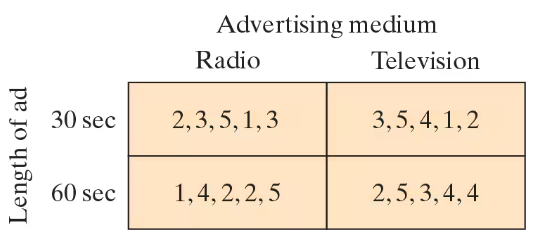
[APPLET] Advertising A study was conducted in which a sample of 20 adults was asked to rate the effectiveness of advertisements. Each adult rated a radio or television advertisement that lasted 30 or 60 seconds. The block design shows these ratings (on a scale of 1 to 5, with 5 being extremely effective).
"
Verified step by step guidance1
Step 1: Identify the factors and levels in the two-way ANOVA. Here, the two factors are 'Advertising medium' with levels Radio and Television, and 'Length of ad' with levels 30 seconds and 60 seconds.
Step 2: Organize the data into groups based on the combinations of the two factors. The groups are: Radio-30 sec, Radio-60 sec, Television-30 sec, and Television-60 sec, with the given ratings in each group.
Step 3: Use technology (such as statistical software or a graphing calculator) to input the data and perform the two-way ANOVA test. This will calculate the F-statistics and p-values for the main effects of each factor and their interaction effect.
Step 4: Set the significance level α = 0.10 and compare the p-values from the ANOVA output to α to determine if there are statistically significant effects for the advertising medium, length of ad, and their interaction.
Step 5: Interpret the results by stating whether each factor and the interaction have a significant effect on the effectiveness ratings, based on the p-values and the chosen significance level.
Verified video answer for a similar problem:This video solution was recommended by our tutors as helpful for the problem above
Video duration:
3mPlay a video:
0 Comments
Key Concepts
Here are the essential concepts you must grasp in order to answer the question correctly.
Two-Way ANOVA
Two-way ANOVA is a statistical method used to examine the effect of two independent categorical variables on a continuous dependent variable. It tests for main effects of each factor and their interaction effect, helping to understand if the factors independently or jointly influence the outcome.
Recommended video:
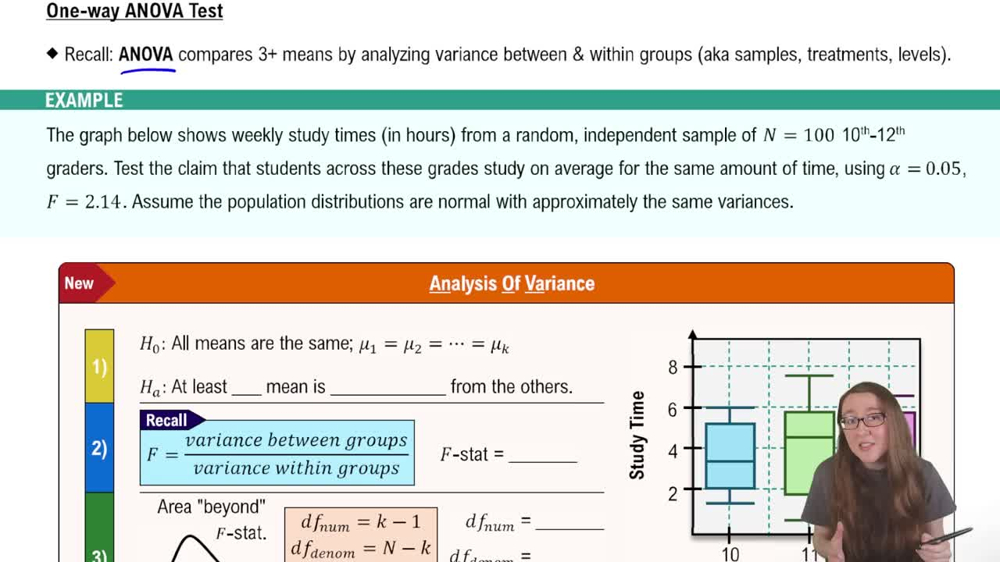
ANOVA Test
Block Design
Block design is an experimental setup that groups subjects into blocks based on a variable to reduce variability and isolate the effects of the factors being studied. In this question, the length of the ad acts as a blocking factor to control for its influence while assessing the advertising medium.
Recommended video:
Critical Values: t-Distribution
Assumptions of ANOVA
ANOVA requires assumptions including random and independent samples, normally distributed populations, and equal population variances. These assumptions ensure the validity of the test results and accurate interpretation of the effects of the factors.
Recommended video:
ANOVA Test
Related Videos
Related Practice
Textbook Question
31
views