
Pancake Experiment Listed below are ratings of pancakes made by experts (based on data from Minitab). Different pancakes were made with and without a supplement and with different amounts of whey. The results from two-way analysis of variance are shown. Use the displayed results and a 0.05 significance level. What do you conclude?
Table of contents
- 1. Intro to Stats and Collecting Data1h 14m
- 2. Describing Data with Tables and Graphs1h 55m
- 3. Describing Data Numerically2h 5m
- 4. Probability2h 16m
- 5. Binomial Distribution & Discrete Random Variables3h 6m
- 6. Normal Distribution and Continuous Random Variables2h 11m
- 7. Sampling Distributions & Confidence Intervals: Mean3h 23m
- Sampling Distribution of the Sample Mean and Central Limit Theorem19m
- Distribution of Sample Mean - Excel23m
- Introduction to Confidence Intervals15m
- Confidence Intervals for Population Mean1h 18m
- Determining the Minimum Sample Size Required12m
- Finding Probabilities and T Critical Values - Excel28m
- Confidence Intervals for Population Means - Excel25m
- 8. Sampling Distributions & Confidence Intervals: Proportion2h 10m
- 9. Hypothesis Testing for One Sample5h 9m
- Steps in Hypothesis Testing1h 6m
- Performing Hypothesis Tests: Means1h 4m
- Hypothesis Testing: Means - Excel42m
- Performing Hypothesis Tests: Proportions37m
- Hypothesis Testing: Proportions - Excel27m
- Performing Hypothesis Tests: Variance12m
- Critical Values and Rejection Regions28m
- Link Between Confidence Intervals and Hypothesis Testing12m
- Type I & Type II Errors17m
- 10. Hypothesis Testing for Two Samples5h 37m
- Two Proportions1h 13m
- Two Proportions Hypothesis Test - Excel28m
- Two Means - Unknown, Unequal Variance1h 3m
- Two Means - Unknown Variances Hypothesis Test - Excel12m
- Two Means - Unknown, Equal Variance15m
- Two Means - Unknown, Equal Variances Hypothesis Test - Excel9m
- Two Means - Known Variance12m
- Two Means - Sigma Known Hypothesis Test - Excel21m
- Two Means - Matched Pairs (Dependent Samples)42m
- Matched Pairs Hypothesis Test - Excel12m
- Two Variances and F Distribution29m
- Two Variances - Graphing Calculator16m
- 11. Correlation1h 24m
- 12. Regression3h 33m
- Linear Regression & Least Squares Method26m
- Residuals12m
- Coefficient of Determination12m
- Regression Line Equation and Coefficient of Determination - Excel8m
- Finding Residuals and Creating Residual Plots - Excel11m
- Inferences for Slope31m
- Enabling Data Analysis Toolpak1m
- Regression Readout of the Data Analysis Toolpak - Excel21m
- Prediction Intervals13m
- Prediction Intervals - Excel19m
- Multiple Regression - Excel29m
- Quadratic Regression15m
- Quadratic Regression - Excel10m
- 13. Chi-Square Tests & Goodness of Fit2h 21m
- 14. ANOVA2h 28m
14. ANOVA
Two-Way ANOVA
Problem 10.R.21e
Textbook Question
In Exercises 21 and 22, (e) interpret the decision in the context of the original claim. Assume the samples are random and independent, the populations are normally distributed, and the population variances are equal.
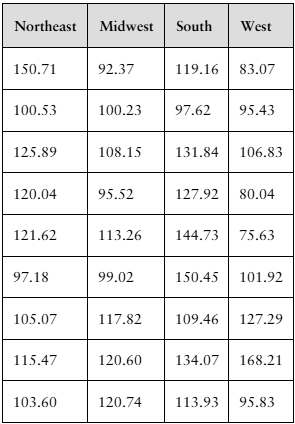
[APPLET] The table shows the monthly electric bills (in dollars) for a sample of households from four regions of the United States. At α=0.10, can you conclude that the mean monthly electric bill is different in at least one of the regions? (Adapted from U.S. Energy Information Administration)

Verified step by step guidance1
Step 1: Identify the problem type and hypotheses. This is a one-way ANOVA test because we are comparing the means of more than two independent groups (Northeast, Midwest, South, West). The null hypothesis \(H_0\) is that all group means are equal: \(\mu_{Northeast} = \mu_{Midwest} = \mu_{South} = \mu_{West}\). The alternative hypothesis \(H_a\) is that at least one group mean is different.
Step 2: Calculate the sample means and variances for each region using the data provided. This involves computing the mean \(\bar{x}_i\) and variance \(s_i^2\) for each group \(i\) (Northeast, Midwest, South, West).
Step 3: Compute the overall mean \(\bar{x}\) by combining all data points from the four groups. Then calculate the Between-Group Sum of Squares (SSB) and Within-Group Sum of Squares (SSW) using the formulas:
\(SSB = \sum_{i=1}^k n_i (\bar{x}_i - \bar{x})^2\)
\(SSW = \sum_{i=1}^k (n_i - 1) s_i^2\)
where \(k\) is the number of groups and \(n_i\) is the sample size of group \(i\).
Step 4: Calculate the Mean Squares: Mean Square Between (MSB) and Mean Square Within (MSW) by dividing the sums of squares by their respective degrees of freedom:
\(MSB = \frac{SSB}{k-1}\)
\(MSW = \frac{SSW}{N-k}\)
where \(N\) is the total number of observations.
Step 5: Compute the F-statistic as \(F = \frac{MSB}{MSW}\). Compare this F-value to the critical value from the F-distribution table at significance level \(\alpha = 0.10\) with degrees of freedom \(df_1 = k-1\) and \(df_2 = N-k\). If \(F\) is greater than the critical value, reject the null hypothesis and conclude that there is sufficient evidence to say the mean monthly electric bill differs in at least one region. Otherwise, fail to reject the null hypothesis.
Verified video answer for a similar problem:This video solution was recommended by our tutors as helpful for the problem above
Video duration:
3mPlay a video:
Was this helpful?
Key Concepts
Here are the essential concepts you must grasp in order to answer the question correctly.
Analysis of Variance (ANOVA)
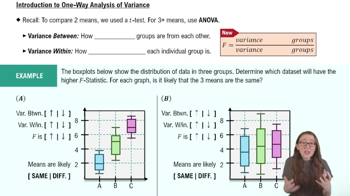
ANOVA is a statistical method used to compare the means of three or more groups to determine if at least one group mean is significantly different from the others. It tests the null hypothesis that all group means are equal against the alternative that at least one differs. This method is appropriate here because we are comparing electric bills across four regions.
Recommended video:
Introduction to ANOVA
Assumptions of ANOVA
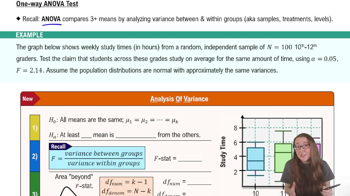
ANOVA relies on key assumptions: samples must be random and independent, populations should be normally distributed, and population variances must be equal (homogeneity of variance). These assumptions ensure the validity of the test results and affect the interpretation of the p-value and conclusions.
Recommended video:
ANOVA Test
Significance Level (α) and Hypothesis Testing
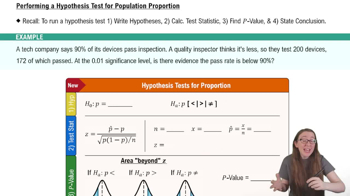
The significance level α (here 0.10) is the threshold for deciding whether to reject the null hypothesis. If the p-value from ANOVA is less than α, we conclude there is sufficient evidence that at least one region's mean electric bill differs. This decision must be interpreted in the context of the original claim about differences among regions.
Recommended video:
Performing Hypothesis Tests: Proportions
Watch next
Master Intro to Two-Way ANOVA & Two-Way Tables with a bite sized video explanation from Patrick
Start learningRelated Videos
Related Practice
Textbook Question
3
views
