
The Federal Bureau of Investigation classifies various larcenies. The data below represent the type of larcenies based on a random sample of 15 larcenies. What is the mode type of larceny?
Table of contents
- 1. Intro to Stats and Collecting Data1h 14m
- 2. Describing Data with Tables and Graphs1h 55m
- 3. Describing Data Numerically2h 5m
- 4. Probability2h 16m
- 5. Binomial Distribution & Discrete Random Variables3h 6m
- 6. Normal Distribution and Continuous Random Variables2h 11m
- 7. Sampling Distributions & Confidence Intervals: Mean3h 23m
- Sampling Distribution of the Sample Mean and Central Limit Theorem19m
- Distribution of Sample Mean - Excel23m
- Introduction to Confidence Intervals15m
- Confidence Intervals for Population Mean1h 18m
- Determining the Minimum Sample Size Required12m
- Finding Probabilities and T Critical Values - Excel28m
- Confidence Intervals for Population Means - Excel25m
- 8. Sampling Distributions & Confidence Intervals: Proportion1h 25m
- 9. Hypothesis Testing for One Sample3h 29m
- 10. Hypothesis Testing for Two Samples4h 50m
- Two Proportions1h 13m
- Two Proportions Hypothesis Test - Excel28m
- Two Means - Unknown, Unequal Variance1h 3m
- Two Means - Unknown Variances Hypothesis Test - Excel12m
- Two Means - Unknown, Equal Variance15m
- Two Means - Unknown, Equal Variances Hypothesis Test - Excel9m
- Two Means - Known Variance12m
- Two Means - Sigma Known Hypothesis Test - Excel21m
- Two Means - Matched Pairs (Dependent Samples)42m
- Matched Pairs Hypothesis Test - Excel12m
- 11. Correlation1h 24m
- 12. Regression1h 50m
- 13. Chi-Square Tests & Goodness of Fit2h 21m
- 14. ANOVA1h 57m
3. Describing Data Numerically
Mode
Problem 2.3.6
Textbook Question
Constructing Data Sets In Exercises 5– 8, construct the described data set. The entries in the data set cannot all be the same.
Mean and median are the same and the data is bimodal.
Verified step by step guidance1
Step 1: Understand the requirements of the problem. The data set must satisfy three conditions: (1) the mean and median must be the same, (2) the data set must be bimodal (having two modes), and (3) the entries in the data set cannot all be the same.
Step 2: Begin by selecting a small set of numbers that meet the bimodal condition. For example, choose two numbers that appear most frequently in the data set (these will be the modes). Ensure that the frequencies of these modes are equal.
Step 3: Add additional numbers to the data set to balance the mean and median. The median is the middle value when the data is ordered, and the mean is the average of all values. Arrange the numbers so that the median equals the mean. For example, you can use symmetry around the median to balance the mean.
Step 4: Verify that the data set meets all conditions. Check that the mean and median are equal by calculating both. Confirm that the data set is bimodal by identifying the two modes. Ensure that not all entries are the same.
Step 5: Adjust the data set if necessary. If the mean and median are not equal or the data set is not bimodal, modify the values or frequencies of the numbers while maintaining the required conditions. Recheck all criteria after adjustments.
Verified video answer for a similar problem:This video solution was recommended by our tutors as helpful for the problem above
Video duration:
5mPlay a video:
Was this helpful?
Key Concepts
Here are the essential concepts you must grasp in order to answer the question correctly.
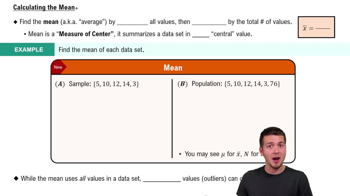
Mean
The mean is the average of a data set, calculated by summing all the values and dividing by the number of entries. It provides a measure of central tendency, indicating where the center of the data lies. In the context of the question, the mean must be equal to the median, which implies a specific arrangement of values.
Recommended video:
Guided course
Calculating the Mean
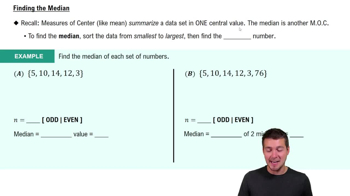
Median
The median is the middle value of a data set when arranged in ascending order. If there is an even number of entries, the median is the average of the two middle values. For the data set in the question, having the mean equal to the median suggests a symmetric distribution around the center, which is essential for constructing the required data set.
Recommended video:
Guided course
Calculating the Median
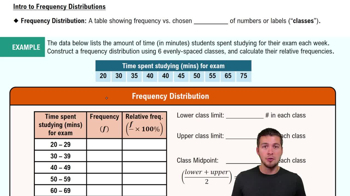
Bimodal Distribution
A bimodal distribution is characterized by having two distinct modes or peaks in its frequency distribution. This means that there are two values that appear most frequently in the data set. In constructing the data set, it is crucial to ensure that these two modes are present while also maintaining the condition that the mean and median are equal.
Recommended video:
Guided course
Intro to Frequency Distributions
Related Videos
Related Practice
Textbook Question
2
views
