
Ch. 2 - Descriptive Statistics
Larson - Elementary Statistics: Picturing the World 8th Edition
Larson8th EditionElementary Statistics: Picturing the WorldISBN: 9780137493470Not the one you use?Change textbook
Chapter 2, Problem 2.3.19

Using and Interpreting Concepts


Finding and Discussing the Mean, Median, and Mode In Exercises 17–34, find the mean, the median, and the mode of the data, if possible. If any measure cannot be found or does not represent the center of the data, explain why.


Video Durations The lengths (in minutes) of seven educational videos from the Public Broadcasting Service (PBS) (Source: PBS)
83 67 90 55 56 119 52

Verified step by step guidance
1
Step 1: Organize the data in ascending order. The given data is: 83, 67, 90, 55, 56, 119, 52. Arrange it as: 52, 55, 56, 67, 83, 90, 119.
Step 2: Calculate the mean. The mean is the sum of all data points divided by the number of data points. Use the formula: Mean=xn, where x is the sum of the data points and n is the number of data points.
Step 3: Find the median. The median is the middle value when the data is ordered. Since there are 7 data points (an odd number), the median is the 4th value in the ordered list: 52, 55, 56, 67, 83, 90, 119.
Step 4: Determine the mode. The mode is the value that appears most frequently in the data set. Check the ordered data: 52, 55, 56, 67, 83, 90, 119. If no value repeats, then the mode does not exist.
Step 5: Interpret the results. Discuss whether the mean, median, or mode best represents the center of the data. Consider factors such as the presence of outliers (e.g., 119) and whether the data is skewed.

Verified video answer for a similar problem:

This video solution was recommended by our tutors as helpful for the problem above.
Video duration:
2m
Was this helpful?

Key Concepts

Here are the essential concepts you must grasp in order to answer the question correctly.

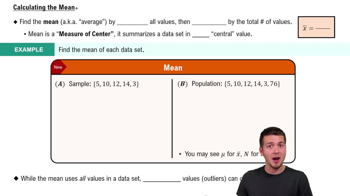
Mean

The mean, often referred to as the average, is calculated by summing all the values in a dataset and then dividing by the number of values. It provides a central value that represents the dataset as a whole. However, the mean can be sensitive to extreme values (outliers), which may skew the result and not accurately reflect the center of the data.
Recommended video:
Guided course
04:52
Calculating the Mean

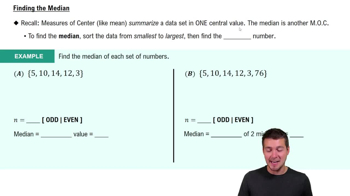
Median

The median is the middle value of a dataset when the values are arranged in ascending or descending order. If there is an even number of observations, the median is the average of the two middle numbers. The median is particularly useful for understanding the center of a dataset that may contain outliers, as it is not affected by extreme values.
Recommended video:
Guided course
03:26
Calculating the Median

Mode

The mode is the value that appears most frequently in a dataset. A dataset may have one mode (unimodal), more than one mode (bimodal or multimodal), or no mode at all if all values occur with the same frequency. The mode is useful for identifying the most common value in a dataset, but it may not always provide a clear representation of the center, especially in continuous data.
Recommended video:
Guided course
07:10
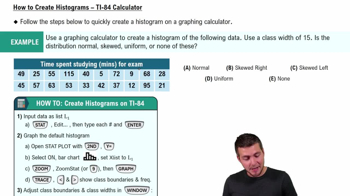
How to Create Histogram - TI-84 Calculator
Related Practice
Textbook Question

Finding the Mean of a Frequency Distribution In Exercises 49–52, approximate the mean of the frequency distribution.


Populations The populations (in thousands) of the counties in Montana in 2019 (Source: U.S. Census Bureau)

126
views
Textbook Question

Constructing a Frequency Distribution and a Frequency Polygon In Exercises 35 and 36, construct a frequency distribution and a frequency polygon for the data set using the indicated number of classes. Describe any patterns.

Declaration of Independence

Number of classes: 5

Data set: Number of children of those who signed the Declaration of Independence (Source: The U.S. National Archives & Records Administration) 5 2 12 18 7 4 10 8 16 3 3 7 3 1 2 7 13 0 8 3 7 5 2 6 0 6 7 9 0 11 9 10 7 8 13 5 8 3 5 0 3 13 3 15 5 6 3 2 5 2 0 3 7 12 4 1

95
views
Textbook Question

Graphical Analysis In Exercises 19–22, use the box-and-whisker plot to determine whether the shape of the distribution represented is symmetric, skewed left, skewed right, or none of these. Justify your answer.

100
views
Textbook Question

In Exercises 37– 40, without performing any calculations, determine which measure of central tendency best represents the graphed data. Explain your reasoning.


" style="" width="300">

88
views
Textbook Question

Graphing Data Sets In Exercises 17–32, organize the data using the indicated type of graph. Describe any patterns.


Smartphone Sales The five best-selling smartphone manufacturers of 2020 were Apple (206.1 million units), Huawei (189.0 million units), Samsung (266.7 million units), vivo (111.7 million units), and Xiaomi (147.8 million units). Use a Pareto chart to display the data. (Source: International Data Corporation)

145
views
Textbook Question

Graphing Data Sets In Exercises 17–32, organize the data using the indicated type of graph. Describe any patterns.


Highest-Paid Athletes Use a stem-and-leaf plot that has two rows for each stem to display the data, which represent the incomes (in millions) of the top 30 highest-paid athletes. (Source: Forbes Media LLC)

39 42 41 45 48 48 106 45 88 54 61 37 62 74 40

47 56 57 105 96 37 48 41 64 52 47 45 59 49 104

118
views